[00:00:05] Speaker A: Welcome to Salon Era, a series from Les Delices that brings together musicians from around the world to share music stories and scholarship with a global audience of early music lovers.
Since 2020, Solanira has premiered over 50 episodes, each of which features a slate of national and international artists sharing live performances, pre recorded content and intriguing conversation you won't hear anywhere else.
I'm Deborah Nagy and this is the third episode in Salon Era's sixth season, Sounds from the Western Frontier in this episode, we'll talk with historian Kim Grunewald and performer scholar Dominic giardino about late 18th century politics as it affected the movement of people and their music as French traders, British soldiers, New American settlers and Native Americans all pushed westward in the decades following the Revolutionary War.
Along the way, we'll sample an early American art song, popular tunes and military marches.
Looking into the 19th century, we'll hear one ballad that promotes homesteading and another that promoted that laments the massacre and displacement of Native Americans.
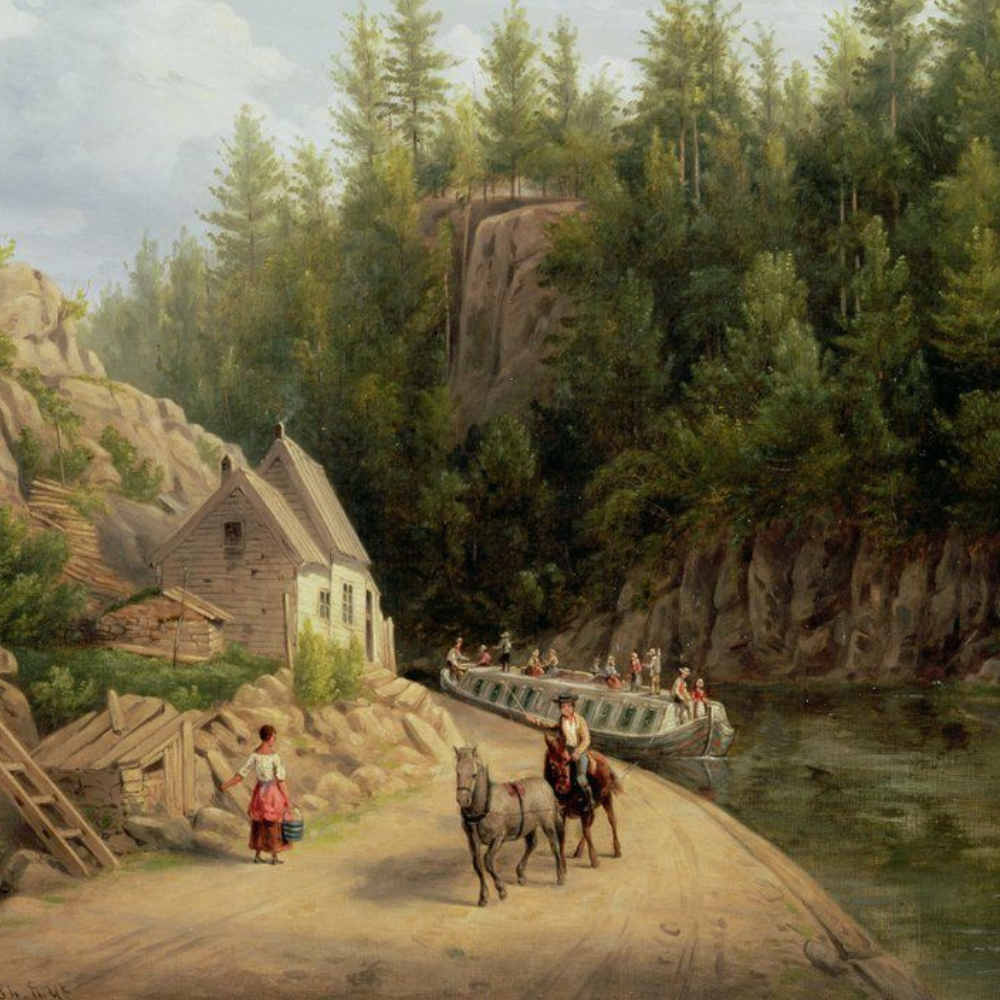
Finally, we'll consider the impact and importance of the Erie and Ohio Canals, opened 200 years ago in 1825 that truly made the U.S. interior accessible prior to trains and steam engines.
Kent State University history professor Krim Grunewald specializes in Colonial America and the early Republic and brings a unique sociology socioeconomic perspective to westward expansion. Has demonstrated in her books river of the Commercial Origins of Regional Identity in the Ohio Valley, 1790-1850 and most recently Philadelphia Merchants on Western Commerce and Empire in the Riverine West, 1750-1803.
Dominic Giardino specializes in performance on historical plan clarinets and is a passionate historian. As a founding member of Music of the Regiment, he works to historically contextualize military musicians and their contributions to music history over the last 300 years.
First up, we'll hear a performance of A Traveler Benighted by Francis Hopkinson. Hopkinson is often cited as one of America's earliest composers. Although he never considered himself a professional musician, he was trained as a lawyer and he had the honor of being one of the original signers of the Declaration of Independence.
Nevertheless, he published a set of eight songs in 1788 that he dedicated to his longtime friend George Washington, A Traveler Benighted is the eighth song in the set, and it depicts the isolated and sometimes harsh wilderness of America's fledgling states and Western frontier.
This performance was recorded live in September 2025 by Les Delices with baritone Tyler Duncan at a special concert inside the Cuyahoga Valley national.
[00:03:44] Speaker B: The traveler, knighted and lost.
[00:03:50] Speaker A: O' er.
[00:03:51] Speaker B: The mountain, pursues his own way the stream is all chanted with frost.
[00:04:03] Speaker C: And.
[00:04:04] Speaker B: The icicle hangs on the spray.
He wanders in hope some kind shelter to find.
While through the sharp still blows the cold wind.
He wanders in hope Some kind shelter to find.
While through the sharp wind still blows the cold wind.
The 10 Best Howls Dreary around and rends the tall oak in its flight.
Fast falls the soft snow on the.
[00:05:09] Speaker A: Ground.
[00:05:12] Speaker B: And dark with the gloom of the night.
No wonders but travel a shelter to find.
While through the soft har thong still blows the cold breeze.
Through the sh.
[00:05:42] Speaker A: Still wind.
[00:06:00] Speaker B: No comfort the wild woods afford.
[00:06:06] Speaker D: No.
[00:06:07] Speaker B: Shelter the traveller can see Far off are his bed and his board.
[00:06:20] Speaker C: And.
[00:06:21] Speaker B: His home where he wishes his heart's cheerful blaze still engages his mind.
While through the sharping blows the cold wind.
His path's cheerful blaze still engages his might Whilst Thor the sharp path waging blows the broken wind.
[00:07:15] Speaker A: Welcome Kim. Welcome, Dominic. I'm so very glad to bring the two of you together. I first started talking with Kim eight or nine months ago in preparation for an early American program that Les Delices produced in the fall, which was called O' Er the Hills in Far Away. And Dominic, we've known each other for quite a number of years and you have been my kind of like, secret guru relative to early American, late 18th century, early 19th century music. And we've had a lot of conversations about it. I'm so excited to bring the two of you into conversation for this episode. But the the thing that I wanted to start with is a question for Kim. When you gave our pre concert talk for over the Hills in September, you introduced the concept that was new to me of frontier as process.
And I wonder if you could unpack that for us.
[00:08:11] Speaker D: Sure.
In 1893, a scholar named Frederick Jackson Turner changed the way historians explained United States history with an essay about what he called the frontier thesis. Turner argued that when Europeans came to North America and had to do battle with the wilderness, that struggle transformed them into something new and unique. Turner defined the frontier as a moving line, the dividing line between what he called civilization and savagery. Waves of fur traders were followed by farmers and then men of commerce in a succession of frontier regions. From the colonial frontier to the trans Appalachian west to the trans Mississippi West.
They created a democratic republic as they swept across the continent from the Atlantic to the Pacific over the course of two centuries.
Turner's story of individualistic, freedom loving farmers battling the virgin wilderness on their own, only to be transformed by the struggle, has long been debunked as Only part of the story. He ignored the stories of Native Americans and slaves. He ignored the role of communities in the federal government. And for me personally, to put merchants and commercial connections so late in the process, well, that had to be wrong.
But thinking of the frontier as a process, as movement, is actually very helpful when it comes to understanding US history. For my favorite time period, the century from 1750 to 1850, and in my favorite place, the Trans Appalachian frontier.
[00:09:50] Speaker A: Dominic, I wanted to bring you into our conversation. Would you like to talk a little bit about the kind of soundtrack of people's lives, specifically where we're thinking about that push westward?
[00:10:04] Speaker C: Absolutely. I think one of the most interesting things is in sort of during this period of imperial crisis, the period between the 1760s and the 1770s, when the American Revolution really breaks out.
It's actually an enormous period of musical development in the British colonies. You have America's first subscription concert series developed in Charleston, South Carolina, in the late 1760s, the St. Cecilia Society. You have the Old American Company actually form just before the French and Indian War in 1752, I think, and they have an active presence throughout the Caribbean, but then also land in Virginia and put on shows in places like Williamsburg and travel up the coast to Philadelphia and New York and back south to Charleston. And of course, there's also this really rich religious musical tradition that had been enduring in New England basically from settlement. I mean, music was integral to Congregationalist churches at the time. So in the 1760s, you actually have the birth of what they called the first New England school of composers. And people like William Billings, who might be the most famous name, might be familiar to the audience of this program.
Now, concurrent to the sort of civilian musical development of the 1760s and 1770s is an enormous presence of military musicians relative to anything the colonies would have experienced before the French and Indian War.
And that's because the French and Indian War up until that point was the largest influx of regular British troops in the colonies. And with many of these regiments came, of course, you're what you might regularly expect as military musicians, fifers and drummers and pipers. It's also during this period that this tradition of using instruments as signal instruments is being called into question.
And so you have the rise of another core of military musicians rising between the 1750s and the 1760s. And that's what we call bands of music. What they would have referred to as martial bands or military bands of music.
And these were professional musicians trained in Europe, doublers on wind instruments and string instruments. And they integrated, actually, with civilian populations throughout the 1760s and 1770s. So when we're thinking about theatrical productions in places like Philadelphia and New York, oftentimes the pit orchestra were made up of some of these bandsmen who were essentially lent out by their. By their colonels and by their regiments. So there's a lot going on. Actually, it's one of the, I think, disappointing factors for music lovers in the 1770s was the Revolution in some ways halted this sort of supercharge of musical culture that was bridging these decades.
[00:12:54] Speaker A: That's so interesting. Dominic, I would love to ask you to introduce the next couple of pieces that we are going to hear, because they are performances by your ensemble. Music of the Regiment.
[00:13:06] Speaker C: Yeah, Music of the Regiment is a project I started about two years ago now with my friend and colleague Dr. Cristroiano. The premise for this project and ensemble is to explore that line between military and civilian music making throughout the 18th and 19th century and really sort of challenging the concept of what military music is, because I think oftentimes we have an idea of what martial music should be and 18th century definitions of. Of that challenge our modern idea.
Now, that being said, what you're about to listen to are two very typical, maybe martial pieces. These two pieces, Hail Columbia and Washington's March, are both representative of grand marches from the period. Hail Columbia is a piece written by composer Philip Feil, who was actually a Hessian oboist who was captured at the Battle of Trenton in 1776 and went on to stay in America after the war and be a leading musical voice in Philadelphia and New York.
So Hail Columbia was written initially as an inauguration march for George Washington in 1789. And then Washington's March is a piece that was popular in banned books throughout the last quarter of the 18th century and throughout the 19th century, and is a great example of a piece of music that was one for one lifted from British regimental culture, because it was actually the march of the 17th Regiment afoot, a British regiment before and during the war, and Washington must have liked it. And American bandsmen penned it in their own books, labeled it Washington's March, and that's its new identity.
[00:14:43] Speaker A: Awesome. Well, thank you so much for that explanation. And let's listen.
Dom, thank you so much for sharing this recent performances from Music of the Regiment. I want to just continue talking a little bit about Western expansion, particularly leading up to the Revolutionary War and the kind of conflicts and discontent that were created by limitations on the press westward.
So, Kim, could you talk us through a little bit more the Idea of frontier's process, particularly relative to the how the French in Indian war and the 1763 proclamation line kind of fomented some of that discontent.
[00:18:07] Speaker D: Sure.
The French and Indian war began in the Upper Ohio Valley in 1754.
Now we officially call it the Seven Years War because England went to war with France from 1756 to 1763, and it soon became a global war with other European empires drawn into the fight. But it started in the wilds of North America because wealthy Virginia investors wanted access to western lands.
At the war's end, Great Britain expelled the French from North America and doubled its territory in one fell swoop.
But the empire also doubled its national debt.
Soon after the war ended, the British began to tax the colonists to raise revenue, and they also declared that there would be no further settlement beyond the Appalachian Mountains until they could get some kind of infrastructure in place to manage it.
Settlement and trade had already begun in the Ohio Valley, and the colonists resented being told they had to pull back.
[00:19:13] Speaker C: The interesting thing to me about the Proclamation line and this issue of westward expansion is actually it's something that, that we see continue to be a problem after the war as well. I mean, it becomes apparent that there's going to have to. There has to be some type of balance between this early version of American libertarianism where everyone gets their own homestead, but then also expects a strong federal government to protect them when they're actively, you know, settling land that is settled by other people.
And one of the things that's interesting about that musically is both in the pre revolutionary period, during the imperial crisis, when you have all of these British outposts on the frontier, you have these bandsmen, these European trained musicians who are stationed at these posts, basically bringing music of the metropole to the farthest frontiers of European settlement. So in some ways, westward expansion, it brings with it sort of a version of conquering a frontier by bringing, I don't know what you would expect to find in a Philadelphia, New York.
[00:20:26] Speaker A: You talked about European bandsmen being sent to these western outposts, bringing the culture of the metropole, you know, from Philadelphia or wherever, into the interior. And how does that evolve post war? And as you're thinking about this great expansion that Kim talked to us about, you know, in the decades after the revolution and say, leading up to the War of 1812.
[00:20:59] Speaker C: Yeah, I mean, as far as the presence of military musicians go, I, I have found that it's essentially a one to one swap. I mean, where there were British outposts, the Americans wanted to occupy those places. And. And have a presence there. And so you would expect to find, I guess, similar institutions set up. And, I mean, it's. Maybe it's important to say that.
I mean, I like to think about music being in the center of all of this. And of course, it's not. And in the 18th century, it very much wasn't. But military bans are a characteristic of essentially a growing desire for centralized authority.
And so, leading up to the War of 1812, it was interesting to me to find actually a recruitment ad from 1812 published in Lancaster, Ohio, that goes on and on about, you know, finding young men to serve their country and all of the stuff you'd expect to find from a recruitment ad for the U.S. army. But at the bottom, there's an asterisk that literally says, good music is wanting such he will be willing to hire or enlist.
And it's a funny appeal, I think, to be publishing in a place like Lancaster, Ohio, in 1812, because the wording to hire or enlist actually implies professional bands meant. It's not actually implying drummers or fifers. So you see, as the United States army is pushing westward, it wants to actually continue as a part of its identity, this very European tradition of having professional military musicians attached to it. But then at the same time, it's so natural that as these settlers are moving west, you have music shops popping up along the Ohio River. And Lexington, Kentucky, is a great example of a city that kind of quickly got its act together musically. I mean, as early as 1798, you have an ad in Stewart's Kentucky Herald advertising music for violin and flute. And within a decade, you actually, or within two decades, you have piano manufacturers setting up shop in Kentucky. And the Gibe family, which was an important German family that moved to America that was manufacturing instruments and dealing instruments, actually setting up a frontier shop in Lexington, Kentucky, where you could buy all manners of military instruments for any band you wanted straight from the ad, as well as pianos and as well as the latest and greatest music that was coming from Philadelphia or New York via places like London.
[00:23:34] Speaker A: That's got to inform us not only about domestic music making, but also, I imagine it must inform us a little bit about the financial capacity of these settlers.
[00:23:46] Speaker C: It seems to challenge, I think, what our. What maybe our popular perception of the west is. And it's something that I really enjoyed about reading one of Kim's books.
Of course, you're going to find homesteaders all over the place, right? There are probably the vast majority of the population are people who are just trying to get by.
But also you have a really sophisticated mercantile system being set up that relies on vastly complicated systems of credit for a clarinetist like me to wrap my head around.
But there were ways of getting these things into people's homes. Kim, it would be great to hear you actually maybe tell us a little bit about that.
[00:24:24] Speaker D: You know, I talk about all those trips to Philadelphia and the hardware and the different people. When do they actually sell pianos? Now, is this post 1800? I mean, they're not selling pianos in 1790, are they?
[00:24:37] Speaker C: Early in the 1810s is when you start to see these music shops pop up. So, I mean, not even. Not even musically speaking. I mean, what's interesting to me, though, is that these merchants who were operating on the Ohio river, had relatively easy access to centers like Philadelphia where they could purchase materials and haul them over the mountains and make them accessible. I mean, musical instruments in some ways are actually just representative of one type of domestic luxury that would have been available to people in the west that we might not necessarily connect to frontier living at this time.
[00:25:12] Speaker D: They can come on steamboats by the 1820s, but you're seeing them, you're seeing these shops as early as 1810. The dates make a big difference.
[00:25:20] Speaker A: The next selection that we're going to listen to is another contribution from Music of the Regiment. A Turkish Quick Step, I understand, is a super popular piece. And I wonder if you could talk a little bit more about that for us, Dom.
[00:25:36] Speaker C: Yes. So the next piece you'll hear is the Turkish Quick Step from the Battle of Prague.
The Battle of Prague was an actual battle in the 1750s during the Seven Years War between Austria and Prussia. But the piece itself, the Battle of Prague, was written in the late 1770s as a programmatic battle sonata. So essentially a piece of piano music that took you through the motions of a battle as it was happening.
And the grand march in the Turkish Quick Step from this piece became enormously popular and transcribed into many, many banned books and reprinted as banned music throughout again, the last quarter of the 18th century and the entirety of the 19th century. And maybe one of the fun things about this, as it relates tangentially to our topic today, is it appears actually that the Battle of Prague, in an offhand way, in Mark Twain's Huckleberry Finn. So it's a. It's a piece, at least on the piano that we know would have been very popular in domestic settings in this region, but undoubtedly would have also been a part of the repertoire of military bands operating between the Western frontier and the east throughout this period.
[00:27:10] Speaker A: Sa.
Thanks for listening to this episode of Solanira which features live concert recordings from Les Delices with baritone Tyler Duncan and from Music of the Regiment featuring our guest Dominic Giardino. Salon Era is available in two formats, first as a video web series on YouTube and at Solaniera.org and as an audio podcast.
All video episodes from season six stream free on YouTube and at saloniera.org from their premiere year through June 30th.
Audio podcast episodes are available anytime at solaniera.org or wherever you listen to podcasts. Podcast listeners can also access exclusive audio only episodes about the creation of Les DeLisa's concert series programs that include musical insights, historical context and audio highlights.
In a moment, we'll hear Rosalind Cassidy Castle, which was first published by scots fiddler William McGibbon under the title the House of Glamis, but it was used by both British and Continental troops to honor fallen soldiers, which earned it the moniker Dead March during the Revolutionary War as well as during the War of 1812. It is performed here by violinist Shelby Yaman and members of Les Delices.
In the meantime, I hope you'll consider making a tax deductible gift in support of Salon era. With your support, we can continue to collaborate with engaging guests from across the country and around the world. You can support Salon ERA by subscribing to this podcast and by
[email protected].
support your donations make every episode possible. Thank.
Welcome back.
It's been a pleasure to enjoy the music on this episode that we've heard already, and places like Lexington, Kentucky Marietta, Ohio have come up in the course of our conversation. And so I wondered, Kim, if you could talk about the Ohio river and its essential role in the expansion of the Western frontier?
[00:32:19] Speaker D: Okay.
After the war, a group of Revolutionary War veterans calling themselves the Ohio Company wanted to purchase a huge tract of land on the Ohio river, and so the Confederation Congress passed the Northwest Ordinance of 1787 to get the sale going in order to attract the right kind of settlers. It promised freedom of religion, due process of law and full civil liberties, support for public education and representative governments. It ensured that territories once settled would become full fledged states, but limited the number to five. You wouldn't want to carve it up into too many states or they'd outnumber the east when it came to decisions at the national level.
But worried about squatters trying to settle the Ohio Valley first, Eastern policymakers granted land in townships to cluster settlers together for defense and sought sites that would give farmers ready access to markets. Under the new settlement scheme, settlers would live close together so they could be properly socialized and educated. The most important thing is that territories would become states.
The new United States didn't plan colonies as the Europeans had done. They intended the territories to be full fledged partners in governing the nation once they became states.
The history of Marietta's first years brings into focus the emerging image of frontier settlements as portals rather than barriers. The Marietta settlers put themselves not too far from the headwaters of a mighty transport system that flowed to the west, away from the old world and onto a new continent. They intended to create a gateway through which others would pass.
Trade would continue down the Mississippi through New Orleans, and industries producing finished goods would grow in the west itself, especially at Pittsburgh and Cincinnati.
They wanted to no less than to provide the foundation for a continental empire for the new nation.
Americans created their empire by planting colonies across oceans, and Americans claimed this continent by going down rivers.
[00:34:49] Speaker A: I think that's. That's a great point. I was wondering what the western frontier and or Ohio specifically kind of represented in the cultural imagination and. Or what kind of promise it held for settlers.
[00:35:09] Speaker D: Americans had this deep attachment to gaining land in Europe. It's just almost impossible. The elite own all the land. And what is so great about America to these people is land. With land you can vote. With land you have power. With land, you have independence.
[00:35:30] Speaker A: But.
[00:35:33] Speaker D: They wanted that land to be attached to transportation systems, to markets. They weren't interested in land out in the middle of nowhere. They wanted land where they could produce something and get their goods to market. So the rivers are absolutely central to that. They want the land to have access to rivers.
[00:35:55] Speaker A: Well, the next two pieces that we're going to hear are kind of.
I would say, in a way, two sides of the same coin. They're absolutely different.
The first is an early 19th century ballad called the Lovely Ohio that I did some research to kind of find and reconstruct. Though it appears in different sources and in different ways and with different texts, the tune actually is one that we know from its original, apparently a tune that kind of came from the U.S.
and, and traveled to England, where it has been kind of preserved. And that that tune is. Has various names, but one of them is Chase the Buffalo and the Lovely Ohio.
I've kind of cleaned up the lyrics a little bit, but it does talk about this kind of homesteading prospect. And in a way, it's almost like an advertisement, I think, for heading west and all the wonderful resources and income potential that you may find there.
But you could also kind of, you know, bring along a lady with you who could, you know, spin and make a nice life.
But of course, you know, we can't have this conversation without considering all of the different populations, most especially native populations, that were being disposable, displaced through this Western movement. And I know we mentioned earlier in this episode also the. The way that Virginia land speculators really wanted to move up into the Ohio River Valley and break up that.
Break up that territory.
And the. The next piece that we'll hear after the lovely Ohio is a piece that's called Logan's Lament or the Blackbird.
And this is basically in circa 1840s poetic gloss on remarks by the Mingo leader James Logan, who lost his whole family and community in a 1775 massacre by Virginians on his.
On his tribe.
And his text was widely published, including in Thomas Jefferson's 1787 Notes on the State of Virginia. Let's listen.
[00:38:37] Speaker B: Come all ye brisk young fellows who have a mind to roam all in some foreign country All a long way from home all in some foreign country along with me to go and we'll settle on the banks of the lovely Ohio and we'll settle on the banks of the lovely Ohio the land it is good boy is of that you need not fear Tis a Garden of Eden in North America Come along, ye lovely lads and we'll all together cold and we'll settle on the banks of the lovely Ohio and we'll settle on the banks of the lovely Ohio.
There are fishes in the river Just fitted for our use there's tall and lofty sugar cane that will give to us its juice there's every kind of game Boy is also the buck and doe when we settle on the banks of the lovely Ohio when we settle on the banks of the lovely Ohio Come along, ye pretty fair maids Spin us some yarn to make us some new clothing to keep ourselves warm for you can knit and sow, love While we reap and mow when we settle on the banks of the lovely Ohio when we sample on the banks of the lovely Ohio Sam, The blackbird is singing on Michigan's shore As sweetly and gently as ever before for she knows to her mate she is pleasure can hide and her dear little brood she is teaching to fly O alas, I am undone the fox and the panther Both beasts of the night Retire to their dens in the gleaming of light and they spring with a free and a sorrowless track for they know that their mates Are expecting them back. O alas, I am undone each herd and each beast Both blessed in degree all nature is cheerful and happy but me I will go to my tent and lie down in despair I will paint me with black and I'll sever my hair O alas, I am undone.
Sam.
I will sit on the shore where the hurricane blows and reveal to the God of the tempest my woes I'll weep for a season on bitterness fed for my kindred hath gone to the hill of the dead. O wallas I am under.
[00:43:39] Speaker C: But they.
[00:43:39] Speaker B: Died not by hunger or lingering decay the steel of the white man has swept them away the snake skin that once I so sacredly wore I will toss with disgust to the storm beaten shore O alas, I am undone.
[00:44:08] Speaker C: They.
[00:44:08] Speaker B: Came to my cabin when heaven was black I heard not their coming and I knew not their track by I saw by the light of the their blazing fuses they were people engendered beyond the big seat O alas, I am undone.
My wife and my children O spare me the tale for who is there left that is kin to Gael?
My wife and my children O spare me the tale for who is there left that is kin to the hail? O alas, I.
[00:45:20] Speaker A: Welcome back.
As we consider the kind of.
I don't know if they're final throws, but they're the final throes of western expansion that we're going to consider in this episode. Kim, I wonder if you could talk to us about the ways in which the canal era, you know, aided in the transformation of the western frontier.
[00:45:42] Speaker D: The river is going to remain the main conduit of trade to the south, but the building of the Ohio Canal would facilitate a changing sense of place among Ohio residents.
Waves of people began arriving in the old northwest by way of the Erie Canal and the Great Lakes instead of the Ohio River. They shipped their crops north by canal.
At roughly the same time, abolition sentiment was growing, so more people were advocating for the abolition of slavery.
So by the middle of the 19th century, the Ohio river ceased to dominate and define the state's growth patterns. When abolition sentiment began to spread, the people with ties to those south of the Ohio made up a much smaller part of the state's population.
As the antagonism between north and south that led to civil war grew, ties between Ohio and Kentucky loosened. And historians of the states bordering the Ohio river would begin to emphasize the Northwest ordinance that outlawed slavery as a boundary rather than a common highway that bound the valleys people together along the northern and southern banks.
It actually Became cheaper to bring a lot of goods north on steamboats up the Mississippi and Ohio valleys and then send them on from there. In other words, it wasn't so much goods coming down the canals. A lot of what went up the canals to the Great Lakes were the crops, were the agricultural goods.
The canals brought people to the northern parts of Ohio and Illinois and Indiana. They took their crops back, but in fact, a lot of the goods came by steamboats up the rivers and then got distributed from there.
[00:47:42] Speaker A: Interesting. Dom, I wonder how you think about the sort of canal era and how that is reflected or affects the kind of musical scene on this kind of region.
[00:48:00] Speaker C: What is most interesting to me about this process, and I think how it connects really interestingly to the generation of the American Revolution, are the folks that are immigrating to the Ohio Valley, particularly in northern Ohio, are folks coming from New England. I mean, it's a highly literate, musically literate and literate population. When you sort of take a broad survey of what the United States was at that time, and I know for a fact at least one bandsman ends up immigrating as far west as Indiana.
You know, it's interesting to try to explore deeper into these folks lives and to see how they brought these musical traditions with them westward. But at the same time, as you have, say, these New Englanders moving west, steam power makes access to places like New Orleans all the more possible. And of course, New Orleans is a major center of musical life, you know, in decades preceding this. What is interesting for me to explore moving forward is what happens, I guess, at this intersection and how, say, French opera and, you know, Bel Canto opera in New Orleans in the first place, half of the 19th century ends up coming northward from the Mississippi.
And at the same time, how goods from the east continue to come over the Appalachian Mountains and make themselves available to this burgeoning population, which. Which does lead then to places like Cincinnati becoming major musical instrument manufacturers in the middle of the 19th century. If we're familiar with the name Wurlitzer, and that's a Cincinnati firm.
So, yeah, it's sort of the culmination of this population explosion that I think is really interesting to investigate musically and how these vastly sort of different influences meet in the middle.
[00:49:56] Speaker A: Absolutely. Well, the final piece of music that we're going to hear in this episode is actually a celebratory ode, if you will, from 1825 that celebrated the opening of the Erie Canal. It makes mention of all the great accomplishments of science and engineering and of course, the great kind of economic opportunity.
So let's finish our episode by hearing the meeting of the waters. Thank you so much for being a part of this episode. It's been great to talk with you both and and thanks for joining us. For sounds from the Western frontier.
[00:50:56] Speaker B: Let the day be forever remember.
[00:51:00] Speaker C: That.
[00:51:00] Speaker B: We held the proud hearts into Erie alive for the last sand of time from his glass shall descend Ere a union so fruitful of glory shall end Ere a union so fruitful of glory shall end.
Yet it is not that wealth now enriches the scene where treasures of art and of nature convene. Tis not that this union our coffers will fill. Oh no, it is something more exquisite still. Oh no, it is something more exquisite still.
Tis that genius has triumphed and science prevailed Though prejudice flouted and envy assailed. It is that the vassals of Europe may see the progress of mind in a land that is is free the progress of mind in a land that is free.
All hail to a project so vast and sublime A bond that can never be severed by time now you unite us still our jealousy cease and our hearts like our waters are mingled in peace and our hearts like our waters unmingled in plea.
[00:53:14] Speaker A: Tune in on April 13 as Salan era premieres. Women at the Keyboard will feature two very special forte piano and violin duos who are bringing the little known music and stories of 18th century women Composer pianists to life.
Our guests are forte pianist Yi Heng Yang and violinist Aislin Noski who recently recorded sonatas by Jane Mary Guest. We'll also talk with and feature recent live performances by Les Delis, keyboardist Mark Edwards and violinist Shelby Yaman as we shine a light on the legacies of Mariana Mozart, Josefa Auenheimer and Maddalena Lombardini. Sir, Thanks so much for listening to this episode of Salon Era. This episode was created by me, Executive producer Deborah Nagy, Associate producer Shelby Yaman and Hannah Depriest, our script writer and Sprinkler projects manager. Our guests were historian Kim Grunewald and scholar performer Dominic Giardino. We heard live performances from Les Delices with baritone Tyler Duncan and from Music of the Regiment, an ensemble of musicians and network of researchers dedicated to the study and performance of 18th and 19th century European and American military music.
Support for Solanira is provided by Cuyahoga Arts and Culture, the Ohio Arts Council and audience members like you.
Special thanks to Sarah Steiner who sponsored this episode of Salanira, and a huge thank you to our seasoned sponsors Deborah Malamud, Tom and Marilyn McLaughlin and Greg Nosen and Brandon Rood.
A one hour filmed version of this episode is available on salon era.org where you can also get full performance details and learn more about the music and information shared in this and any episode.
If you enjoyed this episode, please subscribe. Consider making a
[email protected] or submit a review. It really helps the show.
Sam.