[00:00:02] Speaker A: This is Deborah Nagy welcoming you to Music and Labor, the second episode in Salon Era's 202526 season.
Since 2020, Salon Era has premiered over 50 episodes, each of which features a slate of national and international artists sharing live performances, pre recorded content, and intriguing conversation you won't hear anywhere else you're listening to. Music and labor, the second episode of Solanira's sixth season.
In this episode, we'll consider the types of labor or industries that have musical repertoires associated with them, discuss the history and evolution of sea shanties and related work songs, and consider work songs, relationship to the blues and African American spirituals.
Along the way, we'll sample both historic recordings and recent arrangements shared by our guests, conductor Anthony Tresik King and ethnomusicologist Gib Schreffler.
These days, a lot of people enjoy listening to music while working, but they mostly don't make music to facilitate the work itself.
In the wake of mechanization and other new technologies, work songs that facilitated or unified the labor of a group of individuals mostly became obsolete as a result. We'll also consider varied approaches to preserving and understanding the cultural legacies of these musics.
First up, we'll hear a performance of Stormalong, recorded live at a public shanty sing in March 2025 featuring Shawn, Digger and members of Les Delices.
Stormalong likely began as a tribute to a deceased seaman, but it grew to become a fable of enormous proportions. I'll let Sean introduce it.
[00:01:52] Speaker B: Sea Shanty is not a song to be listened to.
It's a song to be sung altogether.
I'm going to be the shanty man and the other musicians, and each and every one of you is the crew. And you're going to sing from your seats doing your crew job. You don't have to sing, but you do.
So let's get right into it. The first song is called Storm Along. It's about a guy. Oh, he's about twice as high as this building. He ate sharks for breakfast. He he wore smaller ships as slippers. He his ship was so large he kept a stable of Arabian horses to get from one end of it to the other.
He fought the Kraken twice.
So that's. That's post storming.
Storm along and around we'll go Storm, storm along oh, storm along and around we'll go Storm along Me Johnny Old Stormy was a captain bold Storm, storm along A grand old man from the days of old Storm along me Johnny Old Stormy loved our sailor's song Storm, storm along his voice was true and his heart was strong Storm along me Johnny but now old Stormy's dead and done Storm, storm along we mark the place where he was gone Storm along Me Dani I wish I was old Stormy son Storm, storm along I dream Build a ship of a thousand ton Storm along Bijani we'd sail this wild world round and round Storm, storm along with gold and silver we'd be found Storm along Bijani for 50 years we'd sail the seas Storm, storm along we'd have no gales but a good stiff breeze Storm along me Johnny we'll storm along and around we'll go Storm, storm along oh, storm along and around we'll go Storm along me Johnny Storm along Mijani.
[00:04:24] Speaker A: Gab Anthony, I'm thrilled to welcome you to Salon Era. We actually have a rather wide ranging episode to talk about.
But I wanted to start with Gib and to, you know, basically ask this question. What is the relationship between music and labor? A lot of people I know listen to music while they're working. I'm not capable of that.
But music supporting work is a totally different concept.
[00:04:54] Speaker C: Well, I think anybody who's done menial or physical work for a long time knows some of the obvious answers to this.
Just to relieve boredom is one of the huge things. Another one I think is quite obvious for any casual observer is singing potentially could bring social cohesion and camaraderie amongst the workers.
And that's something we're often missing nowadays. There's a shyness in our culture about singing at work. So we don't have that. I think a third thing would be what people's minds would tend to go to would be the coordination of work, the coordination of efforts, or at least the pacing of work. So where my specialty comes in, the shanties usually has to do with a group wanting to coordinate their force and oftentimes wanting to time that work. I believe that the workers actually first and foremost wanted to sing. That was a cultural habit of theirs to want to sing as a group and to feel unified as a group, no matter if they were working or not. So they actually sought work that would enable them to continue practices practicing that type of singing. And I think that's borne out by, like, nowadays when we see people work on ships, they tend not to sing, even though you could say, hey, wouldn't it be easier for you to work if you had the song to coordinate that? But they don't do that. So that leads me to think it's more of a cultural thing than Necessarily something that's compelled by physical function at all times.
[00:06:23] Speaker D: I would definitely agree with that. I think there's a lot of, like, cultural connection to it. When we look at, you know, where particularly some of these work songs in the African American community and culture come from.
If we look back into Africa, there's a lot of singing that is accompanying just about every aspect of life. And so the singing is rooted in the culture.
And so therefore, naturally you would sing while you work, because you sing while you worship, you sing while you celebrate, you sing while you relax. Like you're just singing all the time. And so it just kind of makes sense.
[00:06:57] Speaker A: That's a really great point. And I think the social aspect is so interesting and important. When I was doing a bunch of reading about work songs, I found myself actually surprised to consider, you know, that they're like actually more independent or solo stuff like spinning songs. But I guess, you know, there. There are so many kinds of labor that requires some physical effort and, you know, some rep. A lot of repetition, drudgery and rhythm. Anthony, you chose the next few selections that we're going to hear in this episode. Can you tell us a little bit more about these songs, what they represent or capture and why you chose to share them?
[00:07:45] Speaker D: The first selection, we're gonna listen to Isleboy's Cancellinum and there are two different versions of them. We're gonna hear a field recording first. And it's a 19th century, like, reconstruction era piece in which there's the re. Enslavement of the black population, often for vagrancy. And they were put to work in work camps and building the railroad across the country. And so there's specific tasks to do with the railroad, whether you're pounding railroad spikes or making the tracks parallel because obviously you want them to be going straight. So those track lining songs, Hoboys can't yout Line Them is a track lining song which they were trying to align the work of moving those heavy steel rails so that they become parallel. So you'll hear kind of a solo version. And then there's a recording of the Leonard Depar Chorale singing kind of a 20th century arrangement of that track lighting song. And then the other piece that is by Nathaniel Dett, it's again another 19th century, early 20th century kind of concert spiritual where he took something that he heard from his family, where you hew around the trees. It's basically you're trying to chop down trees. So those are the two examples that we have right now.
[00:09:11] Speaker B: All I hate about Lonnie Tracks these old bosses bodies breaking my back Boys can't you line up Jackalack oh boys can't you line up Jackalack oh boys can't you line up Jackalacky Cl we go on and drag Moses stood on a red T shirt Smoking that water with a pool by poo I hope boys can't line them back at the Hope Boys can't Carolina Jackal at the Hope boys can't Carolina Jackalaciel we go line and drag if I could I surely would stand on a rock one more that stood I hope boys can't Hope boys catch the line and Jackal I hope boys can't lie yeah Louise go line and track Marrying the babies lying in the shade figuring on the money that I ain't made I hope boys can't line up Chap boys can't line up Chaplin Hope boys can't line up chaplain see how we go on and track why all boys is right I don't like.
And known that luck.
Old boys came to light up.
Oh boys where the can wait oh boys where there ain't time oh boys where the can wait See every.
I got a woman in tenerly square if you want to die easy let me get you down I got a woman in genes square if you want to die easy boy let me can't you dare say Home boys can't you hide them Home boys can't idolize Home boys can't you light them see an original light in red Home boys can't you line up Old boys can't you line up I say old boys can't you line up Clb.
We'll light in green Ra.
So wide so high.
Where it falls their shall it like.
[00:13:56] Speaker A: You.
[00:14:03] Speaker B: Wicked man is like the tree you throw your great shall he destroy instruction be.
You from the tre.
[00:15:05] Speaker A: Thanks for listening to this episode of Salon Era, which features a mix of historic recordings, performances by Les Delys with special guest Shawn Dagger, and performances featuring our guests Anthony Tresek, King and Gibbs Reffler.
Solanira is available in two formats as a video web series on YouTube and salonira.org and as an audio podcast.
All video episodes from Season 6 stream free on YouTube and at Solaniera.org from their premiere through June 30th, and audio podcast episodes are available anytime at Solaniera.org or wherever you listen to podcasts. Podcast listeners can also access exclusive audio only episodes about the creation of Les DeLisa's concert series, programs that include musical highlights, historical context and audio performances.
In the meantime, I hope you'll consider making a tax deductible gift in support of Salon era.
With your support, we can continue to collaborate with engagement engaging guests from across the country and around the world.
You can support Salon ERA by subscribing to this podcast and by
[email protected].
support your donations. Make every episode possible.
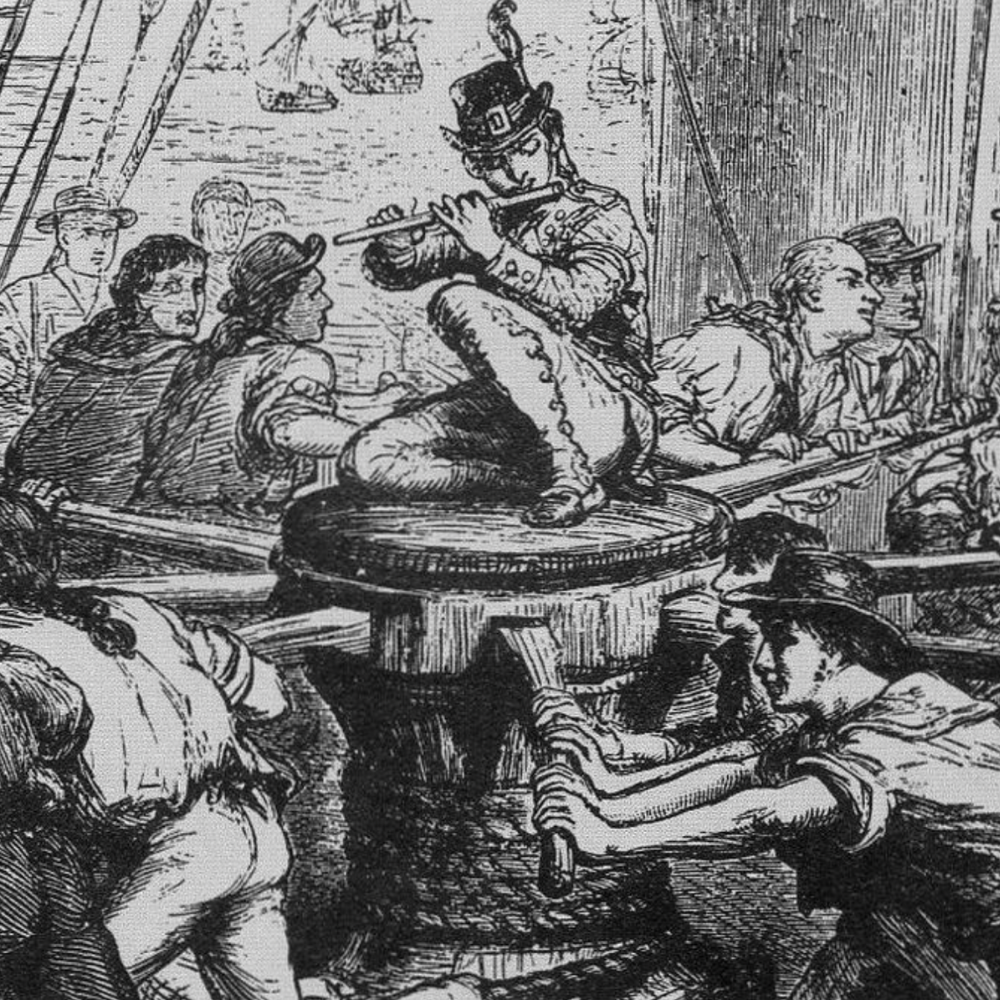
In a moment, we'll preview Songs of the Windless Gibbs Schreffler's documentary that examines the origins of sea shanties, dispels myths and romantic visions of singing sailors, and considers how labor and communal singing truly felt as a crew of eight work the historic windlass that raised and lowered anchor aboard the 125-year-old tall ship Gazella, operated by the Philadelphia Ship Preservation Guild.
Thanks again for supporting Les Delis and Ceylon Era by listening and subscribing to this podcast.
[00:17:24] Speaker B: Did you ever hear tell of that general all upon the place of Mexico?
[00:17:32] Speaker C: The songs known as shanties today often evoke a vision of sailing replete with romantic notions of life unmoored from the dull labors of landsmen, of buoyant sailors in pursuit of adventure and of carefree enjoyment, of of wind and wave.
If ever we begin to wake to reality and remember that the old time commercial mariner's vocation contained its share of desperation and abject toil, these dimly remembered songs, now sung in leisure time, persuade us to forget again, for a singing subject would seem to be a jolly one.
A realistic understanding of historical mariners lives, their actual work, and the nature of the songs they sang while performing their tasks, however, compels us to revise these perceptions.
Shanties were rooted in work singing practices of black people of the Americas.
They were among those practices which, modeled on African approaches but but taking new shape, were developed through the common experiences of alienation and enslavement, and which came to cohere as an African American culture.
As in today's romantic visions of singing sailors, the singing of enslaved Africans at work was once mistaken as a sign of unqualified joy before Frederick Douglass revealed that slaves sing most when they are most unhappy.
A branch of the African American work song complex already widespread among laborers on land, and being a particular form and method of call and response singing that managed both the practical needs of people working in concert and the psychological needs of their circumstances, extended to maritime environments and grew to at last reach the decks of sailing ships. In the 1830s, the genre crossed ethnic boundaries in socially diverse port contexts, such as that of the job of stowing cotton in the cargo holds of ships just how this genre of song, these shanties and their accompanying semiotic frame came to take hold among ocean going mariners outside the African American community is a story of rich complexity.
[00:20:03] Speaker A: Welcome back, Gibb. We just got a taste of your documentary, Songs of the Windlass. How long have you been singing shanties?
[00:20:13] Speaker C: Gosh, 17 years or so. I grew up in Connecticut, close enough distance to the Mystic Seaport Museum, which is one of the premier sites for interpreting 19th century maritime history. So I had that sort of. It was sort of in the water when I was growing up. I got back into it in graduate school because at one of my graduate, graduate school classmates was a great shanty singer named Rebel. Car is a professor now as well. And my current phase was me returning back to it when I was writing a dissertation on stuff in India and Pakistan and I started to listen to the oral histories of those musicians in India. And it started to make me reflect back now on this music that was more close to home. And I thought about all these kind of stories of history that I'm questioning now. Could I train that questioning on my quote unquote own tradition now? And I started by actually going through the largest collection of shanties, not necessarily the best, but the largest collection of shanties that exist, a book by Stan Hugo called shanties from the seven seas. There's over 400 songs in there. And just I said, I'm going to learn all of them. And how do we learn a tradition that's a historical tradition?
You know, we're not existing in the past, so. But nowadays we can learn from a teacher. How can we learn something from the past? Well, we could possibly try to just perform it and see like what happens phenomenologically within ourselves. I thought if I learn these hundreds of songs, I'll start to get an idea of the musical language and the textual language and like how this thing is all put together. So that became a project of mine actually on YouTube since 2008, it was until about 2012to try to interpret in some rough way all of those. And from then I've just gotten more deep into it and my views on these things have evolved over the years.
[00:22:02] Speaker A: Yeah, I'd love to ask you about that. But before we go there, considering this huge repertoire of shanties formally, do they always have a call and response aspect to them?
[00:22:15] Speaker C: They do. I think that's the call and response is not only something we happen to see as a matter of the form, but I think it's probably a socially necessary part of the form. If we said earlier performing these songs was not only something that would facilitate social cohesion, but also the thing I said about. I think the tradition that this is coming from ultimately from African American singing. It starts with social cohesion and community.
Gotta have call and response, because you've gotta have everybody involved in it. But it's part of the practical nature of the form as well, to have the lead singer doing the call and then the group cohesion and the response, wherein the lead singer is going to be able to say whatever they want. And that's like a huge part of the aesthetics of shanties. To be able to say what you want, whatever you want at that moment. Say something that's maybe never been heard before. And that taps into the other thing you asked about the function of work and labor. It's like how to not get bored. Well, someone's got to. Got to say something to you that you never heard before. Like in that moment is going to kick in. It's not so important as how beautiful your voice sounds at that moment, but it's like how interesting what you're doing is. So that lead singer just creates the flexibility of form. So that's why we have a call and response, I think.
[00:23:38] Speaker A: How has your thinking or your approach to shanties or shanti singing evolved over last 18, 20 years that you've been engaged with it?
[00:23:51] Speaker C: Well, I think of it as I find it possible to think of it as a living form of music, a living tradition that can continue. I see the.
What I consider to be the basic elements of the genre continuing on basically to the present day. Champions aren't limited to seafarers as a genre of music. I think they came from non seafarers. They come from many different sites of African American music in different contexts of both work and play and worship. That form just continued, continued on at least up into early hip hop.
And to perform this historical genre doesn't mean to repeat exactly what was done in the past. You've got to create your own thing, but you're creating it within a very similar form.
So that's my approach to the performance of it. I like to take it as the form in which we can pour our new expressions in the present day.
[00:24:51] Speaker A: Let's talk for a moment about physical work. You did this documentary songs, the Windless, and we saw this crew engaging with the physical work while singing. And what did you learn from that experience?
[00:25:09] Speaker C: That was a really kind of rarefied moment because we were working on the Barkington Gazella in Philadelphia.
And I think it may be the only vessel that has this one particular item called a lever windlass, that's actually functional and is of the sufficient kind of size and construction to give us a sense of, like, what they had on ships in the 19th century. You get a sense when you work on that, of, like, the. The great effort involved the fact that you have to pace yourself, the fact that getting up at anchor could take hours to do. So over, you know, what you. That's a lot of singing. That's a lot of songs you can do. And there's like, these different moments in the process of getting an anchor up where the work varies. So across the whole process, which might be hours, there's different feelings to it. So you're thinking of, like, how to. How to pace yourself. How many songs I need. The shanty man, which is the name of the lead singer, needs to, like, really have this. This inventory of verses or really great wit to be able to keep making up stuff. You're going to run out. Whatever's written down in the books that you're reading, you're going to run out of that really quickly.
And a second thing I'll just mention is, like, the singing style. You're outdoors. There's other kinds of noise and sounds going on. Your voice dies immediately. You've got to sing in, like, your uppermost register that you have. Even if you would think in a concert hall, that wouldn't be the most beautiful sound for your own vocal register, you sing in the uppermost register. You've got to use different, like, extended vocal techniques to sometimes give the illusion of sort of a power in your voice. Even if you become tired or you don't have the power in that register, you've gotta. You've got to overlap your singing with the singing of the chorus as well.
You've got to know how to. Because you're working as well, but you're maybe working in a position that's a little lighter working others. You've got to know how to kind of save your breath for that because you really are in the traditional sense, like, in the position where you have to.
You're in charge of, like, directing.
Directing the work with your voice.
[00:27:17] Speaker A: It's so fabulous to hear you talk about that. We're going to hear now, actually, a performance of you and the Gazella crew at the Windlass singing Shenandoah or the Wild Missouri.
Can you talk to us about what we're going to hear?
[00:27:38] Speaker C: Well, Shenandoah, I would hope many of your viewers know the song Shenandoah. I Consider it to be like one of the all time classic American pieces. And I think that's one thing most of the world can agree on. Shenandoah is an American song. Even, you know, President Biden said it was his favorite song. It was like his theme song almost. But I think what most people don't realize is that Shenandoah was a shanty. Every place that the song Shenandoah was ever mentioned before it became a concert piece was in the context of. Of labor on a ship.
I've done a statistical survey of like how popular various shanty items of repertoire were in the main period of shanty singing. Roughly late 1830s to about 1914. Shenandoah was like number six. It was the number six out of the top ten most ever sung shanties. So I think that part and the fact that knowing it's a work song really has some implications of like how we imagine it sound. Because so many of the performances we hear or we see transcribed in books are not written in a regular meter.
Or they may be written in 3, 4, and 3, 4 doesn't work for a work song. It's got to be a duple meter or quadruple meter. And odd metrical lengths do not work either. This thing, the windlass on the ship is going back and forth, back and forth, binary.
So I was really challenged to figure out how what the sailors actually sang fit that work action. And I think we'll see how it works out.
[00:29:13] Speaker A: Awesome. Let's listen.
[00:29:15] Speaker B: You shiny doe I long to hear you Hoorah, you rolling river oh shiny door I long to to hear you unbound way on the wild Missouri for seven long years I courted Sally Are you rolling river for seven layers down in yon valley? Yaha. I'm bound away on the wild misery oh, it's seven long years I was a Frisco traitor who are you? Olive river oh, seven years more I was a Texas Ranger I'm bound away on the wild Missouri oh, it's seven long years I courted Sally Hooray. Are you rolling river A port Sally down in yon valley Aha, you bound away on the wild misery A Yankee ship come down the river Hooray River A Yankee ship come down that river I bow away from the wild misery that Yankee ship rolling down the river Hurrah.
Rolling river and every step her topsails quiver.
On the wild.
Who do you think was the skipper of her? Hooray, you rolling river A jim along Joe was a skipper of her Aha. I'm out of the way on the wild misery oh, Jim along Joe lad Blue nose hard case Hooray, you rolling river oh, sack her up a bill that blue nose bugger. I'm bound away on the wild misery and what do you think she hats for cargo? Hoorah, you rolling river she had sugar and rum and monkeys live.
On the wild Missouri O senador, I love your daughter who are you?
I love the place where she makes her water I'm bound away on the wild Missouri and Sally Brown Washing Bridge Brown's daughter Rolling river Sally Brown was Jim Brown's daughter I'm bound away on the wild Missouri oh, Sally Brown I long to hear you who are you rolling river Sally Brown I can get.
[00:32:57] Speaker C: Near you.
[00:33:01] Speaker B: On the wild misery.
[00:33:08] Speaker A: Welcome back.
We have been hearing from Gib about shanty singing and the physicality of work songs. And, Anthony, I want to bring you back into our conversation to talk about the relationship to the blues and spiritual repertoire, which you have done lots of research into yourself.
[00:33:32] Speaker D: Yeah, I certainly look at and try to research and understand the spiritual and kind of the origin of the root of the African American tradition here in this country. And in that part of that, obviously, is work songs. And part of the work songs are sea shanties. And so a lot of the same characteristics that Gibb was talking about, the way it's structured, the call and response form, is in there at the root with spirituals. It kind of does evolve into slightly different forms as we go through, but essentially at the core of it is this calm response, starting with the ring shout, and kind of developing from that. Textually, there are some differences. Like one of the things that struck me when I'm looking through some of my spiritual books, whether it's the slave songs of the United States or these American Negro folk songs by John Wesley work, is that if you look at the text, especially in relation to spirituals, there are vague references to God. Right. But they're not always like, right, full on, you know, something that is of the scripture. And so you can certainly tell that there is a lot of work song implications in that or secular implications into that. And as we look at the kind of the tree of American music, black American music, we have the work song at the root. The work song, those field hollers, the ring shouts, all of these things, they happened before the official spiritual because at first we weren't proselytizing to the African American community. That was a later addition. So we have more of these spirituals that are not necessarily related to any kind of deity.
But Then one branch becomes very sacred. And if you follow that branch, eventually it would end up with the gospel music and so on.
But this work song branch kind of keeps going and it takes on its own characters and remains secular.
And through those work songs of.
Of the period of enslavement. And then you go into reconstruction, where there was the re. Enslavement of the black population, that eventually becomes the blues. There's a third branch that we haven't talked about so much, and that is kind of an instrumental branch where the dance music and that also heads us off into jazz.
So there's just lots of like, kind of a rich history of music in which all of it is kind of related to each other, and all of it is about kind of creating this sense of community and connection.
So I think it's really kind of fascinating because in these spiritual books we do have sea shanties. And to me, that was kind of a discovery for mine as I was going through, because we do think of the sea shanties to be something separate, but they're not. They're actually very much in the core of this literature.
And so that, to me, I think, was really quite fascinating.
[00:36:27] Speaker A: Can I ask one quick question first? I don't know that what a ring shout is.
[00:36:32] Speaker D: What it was is that in Africa, a lot of the same traditions were brought over, but they had to be reinvented because it was a different culture. And the ring shout essentially is where you have a person in the middle who is your caller, right? They give the call, and there might be another person or two in the middle with them who is doing some sort of percussion. Often it would be body percussion, but then it would be surrounded by the response.
And it's kind of a spiritual moment in which they would call. The caller would shout and call, and then they would respond and they'd walk. They would shuffle around in the circle, right? And it's important that it's a shuffle because showing the bottom of your feet is unholy. And so you just kind of shuffle along and do that. And oftentimes when I'm teaching choirs about spirituals and ring shouts and work songs, I will actually get them in a shuffle because you think about it, if you're enslaved, whether you're during the pre Emancipation Proclamation or in a chain gang, for example, you know, oftentimes your feet are bound. You can't walk long steps anyway. And so the shuffle is kind of paramount to doing that. But the music makes sense when you put it into context. Like when you're Physically doing something that reminds you, whether it's a ring shout or if it's the movement of a word. It is still possible to hear ring shouts today in the Georgia Sea Islands. You can head down to Georgia Sea Islands and they have festivals, the Gullah Geechee festivals, in which you can actually see them doing the ring shouts. It's really a fascinating piece of culture.
[00:38:04] Speaker C: I'm really interested in looking at these forms for their musical formal details. So I see like, these forms as like being the core of them being pretty similar. You just kind of manipulate how you rearrange lines or you manipulate how your body interacts with it.
[00:38:22] Speaker D: I also think about the texture itself and the heterophonic texture. The fact that everybody's essentially singing the same thing, but they are allowed to or encouraged to make their own version of it.
So it could sound incredibly complex to the listener because everybody has a little bit of autonomy to do it.
So when we think about four part harmony, that wasn't a thing. It was. It was essentially a call and a response and then the response was the same. Everybody singing the same thing essentially, but modifying it to go. To kind of change it. So that to me, the complexity of it and what you're able to do it. And modern day singers aren't used to doing that. And so they have to be retrained to sing wrong notes and wrong rhythms.
[00:39:05] Speaker A: I think that's awesome. I would love to talk more about how these.
These songs kind of exist in the present, including how you approach working on them with students or choirs or an arrangement. But first, I would love to have you, Anthony, introduce the next two selections that we're going to hear.
[00:39:27] Speaker D: Yes. So we're going to hear a sea shanty that was from this collection of slave songs of the United States. And it's called Stand the Storm. And this is a modern version of it. So what I was trying to do is capture the ideal essential aesthetic of the sea shanty. And the other piece is I Want to Go Home. It is a single line of text. The way that it was kind of dictated is essentially a chant. And so when I was creating the arrangement, I had to rewrite the chant and give it some sort of rhythmic structure to it.
And what I found fascinating for me is because I'm not a real composer, I don't fancy myself as a real composer.
But I think that gives me an advantage in this music because I basically sing what I feel is right.
And when I first set I Want to Go Home, I tried to compose it and I got done. And actually I think it was really neat, but it was really complex. It's like this thick eight part texture. And I was like, this is not how. Nobody would have improvised this. And so let me go through and try to improvise. If I were to improvise what the harmony is. And I took this piece, just a melody of it. And I worked with a group in Norway who they only sing through improvisation. And I gave them a couple parameters and they improvised what I wrote down on the first first pass through. So that way I was like, oh, then I got it right. Because this is. If you were to improvise it, this is how it would be. So those are the two songs.
Stand the Storm, which is performed by the Handel Haydn Society.
And then I Want to Go Home, which is performed by the voters eight scholars.
[00:41:16] Speaker B: It won't be long we'll anchor by and by Stand the storm it won't be long we'll anchor by and by oh stand the storm it won't be long we'll anchor by and by oh brother Stand the storm it won't be long we'll anchor by and by My ship is on the ocean we'll anchor by and by My ship is on the ocean by and by O stand the storm it won't be long we'll anchor by my oh brother Stand the storm it won't be long we'll anchor by and by she's making for the kingdom we'll anchor by she he's making for the kingdom Will anchor my and my voice Sandstorm it won't be long will anger by and by oh brother Sandstone it won't be long Will anger by and by I.
Will anchor by and by H.
Will anchor thine host and the stormy war.
It won't belong with Anchor by am I.
There's no rain to wait you.
Oh yes.
I want to go home.
I wanna go home.
There's no sun to burn you there's no sun oh yes.
I want to go home.
I wanna go home.
There'll be no hard trial.
Oh yes.
I wanna go.
I wanna go.
[00:44:51] Speaker C: Home.
[00:44:56] Speaker B: There's no whips to crack.
I wonder.
There's no slavery.
[00:45:36] Speaker A: In the kingdom.
[00:45:42] Speaker B: Oh yes.
I wanna go.
I wanna go Please come and take me home.
There's no stormy weather.
[00:46:16] Speaker C: There'S no stormy weather.
[00:46:29] Speaker B: I want to go home.
[00:46:39] Speaker C: I said I want to go I.
[00:46:42] Speaker B: Need to go I got to go I need you to take me.
Home.
[00:47:05] Speaker A: Anthony, thanks so much for sharing those performances. It's been so great to talk with both of you about these historical traditions, but they obviously exist for us in various ways in the present.
[00:47:18] Speaker C: Well, I'm, you know, interested in, I'd say, to a certain degree, repairing erasure in history and reviving cultural memory.
And I think that we can do that with performance.
And I think the reason why we need to do that, we need to do that with performance is because performance has such an effect on people. I mean, I deal with books, books, books every day, but who's reading those books? People are listening to things. People get their impressions of history from the things they mainly experience in the world, including music.
So within, like this subgenre of shanties and how it's performed, typically nowadays, unwittingly, performers in their performances channel their expressions to accord with their understandings of the history of that genre. And there's nothing wrong with that. And that makes total sense. Of course you're going to perform according to the idea that's in your mind.
Now, I happen to think as a historian that the idea that a lot of people have in their minds need some revision and alteration.
So I see it as if that's the only type of performance that you see.
Those performances that emerge from those understandings, those are just going to continue to make an imprint on others minds who experience it and foreclose on the ability, like, in a way, make my work as a historian harder. When I try to present my ideas, even rhetorically, even through text, people read my work and like, huh, what are you talking about?
If through my performances I can show you, like, if you just kind of hear it in the right context with like the. The nudge in, you know, another direction that doesn't have the nudge in the other direction, then it's going to really make an impression on you. So we've got. We have people like, for example, historically, who put together collections of shanties who were quite biased and selective in what they wanted to include. So I'm kind of like trying to work both sides of like, the history, but then see how the performance side can also work to, like, to steer things, to move the needle a little bit towards a direction that I think will help not, you know, not to create my own bias, but to, you know, put us more on the track of what I think is an accurate cultural memory.
[00:49:46] Speaker D: I think that's so important, Gib, that we do have people out there that are unearthing the history behind some of this music. My first approach to singing spirituals and work songs is, is to do a lecture on the history of the Music.
Because I think it's impossible to sing it correctly without having at least a grounding in the history. And our history has been woefully inadequate. Like through schooling. And especially our music history is woefully inadequate.
So kind of contextualizing at first and knowing that a lot of the music was a means of survival, right? It's something that you had to do to get through your day. You had to do because it's finding hope in a hopeless situation. When you just contextualize it, it changes how you sing them.
And then it's from there, it's just kind of working out some performance practices, some different techniques.
The spirituals that I arrange require improvisation in order to complete them.
They're not concert spirituals. I want us to try and experience something that you might have, even though it's not, but you might have heard prior to 1863. It has to be completed by the community in which we're creating in that moment, which in itself is where the music has come from. It had to be completed by the community, had to be perfected by the community.
And that's what we go for. And that takes practice because we're not used to doing that as choral organizations.
And oftentimes what I'll do is I'll just start singing. I'll do a call and they respond. And at very first is just copy me.
And as you start to feel comfortable, change some of it. Sometimes it's just. I'll just do the call and response and we'll create the peace between us in that particular moment.
[00:51:31] Speaker A: It's been so great to talk with both of you. I learned a lot. You're brilliant. And this is such a rich topic to explore. We're gonna close our episode now with two excerpts, two shanties. Our guest, Shawn Dagger, was our shanty man for these performances. And we'll close out this episode with goodbye fare, you and Lever. Johnny, thanks so much for joining me.
[00:52:01] Speaker B: Oh, don't you hear the old man say Goodbye Farewell, goodbye, farewell oh, don't you hear the old man say Hurrah, my boys, we're homeward bound we're homeward bound to see the old town Goodbye fairly well Goodbye, fatty well, stamp up me boys and he bits around Hurrah, me boys we're homeward bound Our girls will meet us and what will they say? Goodbye, Fetty well, Goodbye, Fetty well. Oh, here comes Shawnee with thought of his pay the rummy boys were homeward bound Evil work, Evil wet he owe it, he owe oh, he with the well boys he long and strong. Goodbye fairy well, goodbye, fare thee well and sing us a chorus A boy good song. Hurrah me boys, we're home without and when we get home no, we won't fly around Goodbye, fare thee well. Goodbye, farewell. We'll heave up the anchor to hear this. What a sound. Hurrah me boys, we're homeward bound. We're homeward bound don't you hear the maids say? Goodbye Fatty. Well, goodbye Fatty well, oh come the cat fall and run away.
Hurrah boys, were homeward bound. Evil wet. Evil wet.
Our money in one week on shore. Goodbye F. Well, goodbye F. Well then our guys go to sea for some more harami boys, we're homeward.
I thought I heard the old man say Leave her Johnny, leave her Tomorrow you will get your pay and it's time for us to leave her Leave her Johnny, leave her oh leave her Johnny, leave her Gonna point Jesus done and the winds don't blow and it's time for us to leave her I hate to sail on this rotten tongue Lever, Johnny Lever no grog loud and rotten grub and it's time for us to leave her Lever, Johnny Lever oh Lever, Johnny Lever for the voyage is done and the winds don't blow and it's time for us to leave her we'd be better off in a nice clean jail Leave her Johnny, leave her we're smuggled in girls and smuggled in hell and it's time for us to leave her Leave her Johnny, leave her oh leave her Johnny, leave, leave her for the voyage is done and the winds don't blow and it's time for us to leave her.
All the cooks are drunk and the mate is too Lever, Johnny Lever the crew is for seen men to few and it's time for us to leave her Lever, Johnny, leave her oh Lever, Johnny lever For the voyage is done and the winds don't blow and it's time for us to lever we wear those packet ships I say Weaver Johnny Lever we'll steal your stores and your clothes away and it's time for us to leave us oh leave her Johnny, leave her for the voyage is done and the winds don't blow and it's time for us to leave her we swear by our own poor want of more Leave her Johnny, leave her the voyage is done so we'll go on shore and it's time for us to leave her Leave her Johnny, leave her oh leave her Johnny, leave her for the voyage is done and the winds don't blow and it's time for us to leave her Leave her Johnny, leave her oh, leave her Johnny, leave her for the voyage is done and the winds don't blow and it's time for us to leave her.
[00:57:53] Speaker A: Tune in on February 2nd 16th as Solaniera Premier's sounds from the Western Frontier.
In this episode, guest historian Kim Grunewald and performer scholar Dominic Giardino consider the music and sounds that reverberated across the Western frontier as French, English, New American settlers and Native Americans pushed westward in the decades following the Revolutionary War.
This December you can enjoy Les Delices concert film of Noel Noel for just $20.
Available to rent December 1 to 31 on Les Delices Vimeo Channel. Noel Noel blends heartfelt carols with both classic and contemporary poetry read by longtime Cleveland radio and TV host Dee Perry to create an alternative lessons in Carols experience.
Les Delices original arrangements of carols from French, English and German traditions will be interleaved with poems by Christina Rossetti, E.E. cummings and Thomas Campion, plus wonderful recent work by Northeast Ohio poets Dave Lucas, Diane Kendig and Julie Werther.
Visit ldmusic.org to learn more or you can check out our channel at Le Dalice VHX tv.
Thanks so much for listening to this episode of Solanira. This episode was created by me, Executive Producer Deborah Nagy, Associate Producer Shelby Yaman and Hannah DePriest, our scriptwriter and Special Projects Manager.
Our guests were Gibbs Schreffler and Anthony Tressek King. Featured performances include historic recordings made by Huddy Lead Belly Ledbetter and Harry Belafonte's the Long Road to Freedom Project, publicly available recordings by the Nathaniel Dett Corral and performances shared by our guests Anthony Tressa King and Gibbs Schreffler. We also heard recorded live performances by Les Delices featuring special guest Shantyman Shawn Dagger. Support for Solanira is provided by Cuyahoga Arts and Culture, the Ohio Arts Council and audience members like you. Special thanks to Sarah Steiner and an anonymous donor who sponsored this episode of Salanira. Amy and Michael diamond sponsored our guest artist Gib Schreffler, and a huge thank you to Solaniera's season sponsors Deborah Malamud, Tom and Marilyn McLaughlin, and Greg Nosen and Brandon Rood.
A one hour filmed version of this episode is available on Salaneera.org where you can also get full performance details and learn more about the music and information shared in this and any episode. If you enjoyed this episode, please subscribe. Consider making a
[email protected] and submit a review. It really helps the show.