[00:00:00] Speaker A: Foreign.
[00:00:05] Speaker B: Welcome to Salon Era, A Salon experience for the 21st century. Solanira is Les Delices signature podcast and web series.
Blending performances, historical deep dives and artist conversations, Solanira has cultivated a fiercely curious, supportive community of listeners.
I'm your host, associate producer Shelby Yaman, and and this is our Solaniera Spotlight on Yankee Doodle.
Today you'll hear music recorded by Music of the Regiment members of the U.S. army's Old Guard Fife and Drum Corps, Kyle Collins of the Colonial Williamsburg foundation and Les Delices.
I'm thrilled to be joined by Music of the Regiment founder and scholar Dominic Giardino. Let's dive in.
[00:00:55] Speaker C: So welcome, Dominic.
[00:00:57] Speaker A: Thank you, Shelby. I'm very happy to be here. Back on Salon Era, we just heard
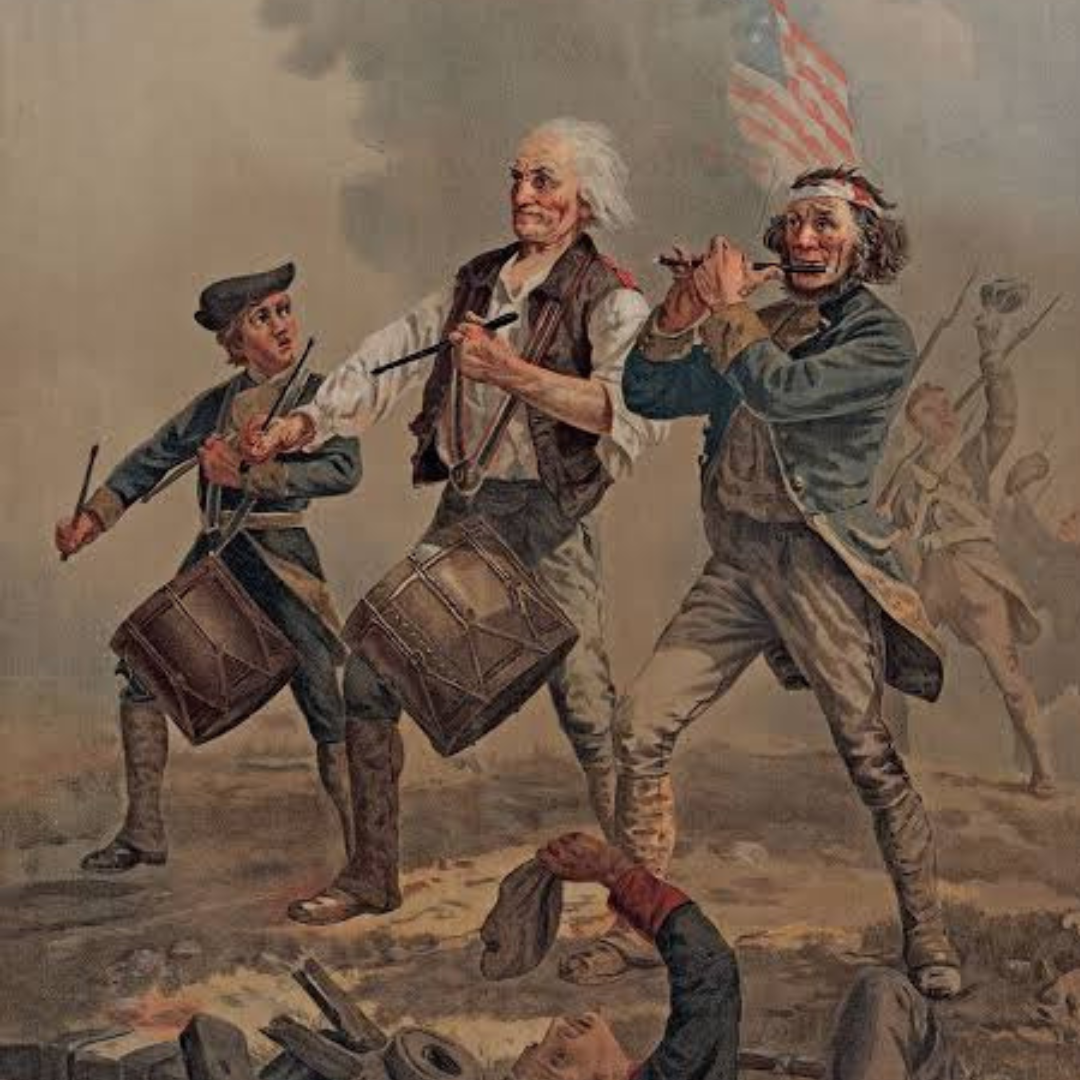
[00:01:02] Speaker C: a snippet of Yankee Doodle played on fife and drum by Emily Barone and Kevin Dill, who are members of the U.S. army's Old Guard Fife and Drum Corps. So I think a good place to start is to talk about whether this piece was originally meant for use in a military setting and anything else you can tell us about its origins.
[00:01:22] Speaker A: Sure. So not to make for a very short podcast, but the fact of the matter is we actually don't really have too many definitive answers about the origin. A few things we do definitely know.
It seems that the tune itself come from a 1730 music manuscript from a New Hampshire reverend.
And I guess to address the first part of your question, like so many military heirs, this tune actually again seems to have made the leap from being a folk tune to a martial tune. But there are strong arguments that suggest, as mysterious as the origins of this tune are, that it is probably a totally New England or American song, as in the tune originates from New England and the lyrics also probably originate from New England.
And regardless of that, what is like absolutely 100% true is there are no people more strongly associated with Yankee Doodle in the last half of the 18th century than New Englanders.
[00:02:25] Speaker C: How did it then become a British military tune?
[00:02:28] Speaker A: The answer lies in it being a popular folk tune first, that then sort of makes its way into military camp life and then is adopted as is a march. Right. So there were no people more British than American colonists. And it's not so far fetched to imagine a fifer in the British army hearing that tune, writing it down and you know, the song disseminating amongst the regiment.
[00:02:57] Speaker C: I think you're the perfect person to give us an idea of the this distinction, like how was Yankee Doodle played as field music and how is it used for entertainment yeah, it's an interesting question.
[00:03:08] Speaker A: I mean, like we. We heard earlier, the most common martial instrumentation for Yankee doodle in the 18th century is undoubtedly the fife and the drum, but the tune would have undoubtedly been a part of the folk repertoire, you know, so, that being said, it's its most tangible function in British and American militaries in the 18th century came from its use as a march. And its practicality starts and stops at its ability to keep soldiers moving in time. But as a popular heir, it carried a political dimension. So because it referred to New Englanders, oftentimes in sort of a teasing, derogatory way, the British army used it throughout the 1760s during the Imperial Crisis, the period that led up to the American War for Independence, as a tune that mocked Americans. And we know for a fact from eyewitness reports that as British soldiers were disembarking in the port of Boston in 1768, the Yankee Doodle tune was amongst the foremost works performed by British bands of music.
Now, what's funny about that is when the Americans start to cultivate this independent identity, this narrative gets turned on its head, and it goes from a tune that is teasing Americans to a tune that, you know, makes the British run back home with their tail between their legs, so to speak. We had this great quote that was published a month after the battles of Lexington and Concord that I can quickly read here.
It reads, when the second Brigade under Earl Percy. So this is the British army, marched out of Boston to reinforce the first, which was then retreating from Lexington and Concord. Nothing was played by the fifes and drums but Yankee Doodle. Upon the return to Boston, one asked his brother officer how he liked the tune now, and he replied, damn them. They made us dance till we were tired.
So, you know, it's this tune that goes from teasing the Americans to punishing the British.
[00:05:06] Speaker B: Yeah, that's a really great quote.
[00:05:09] Speaker C: So your ensemble music of the regiment recently performed and recorded an arrangement of Yankee Doodle that you did, and we're about to hear it in just a moment. Can you tell us a little bit about this arrangement before we listen?
[00:05:23] Speaker A: So the version of Yankee Doodle that you're about to hear comes from a larger arrangement of a medley of tunes that I put together for some concerts this past spring.
And I suppose what's notable about this arrangement, as opposed to what we heard at the beginning of this program, is that instead of being performed on the fife and drums, I've actually arranged this out for the common instrumentation of military bands from the period. So two Clarinets, two horns and two bassoons.
And just to give a little bit of context, the Yankee Doodle comes at the end of this. This medley that showcases tunes associated with those who were on the British side during the Battle of Yorktown. And so the fake ending of this medley is actually the dead March from Handel's Saul.
And that dead march to commemorate the fallen is interrupted in a sort of burlesque, what I called, like, Looney Tunes way by Yankee Doodle. So. So I think it sort of sticks into the tradition of Yankee Doodle being a comic portrayal and a proud portrayal of the goofiness of American character.
[00:06:37] Speaker C: Fantastic. Let's take a listen.
[00:06:51] Speaker A: Sam,
[00:07:28] Speaker C: Thank you so much for sharing that recording with us. I remember being in the audience for one of those performances, and when you got to the Yankee Doodle, kind of unexpectedly, it did elicit this, like, a chuckle, and you could tell that the audience was really tickled by that.
There were many different lyrics associated with it, but the ones that stuck around were Yankee Doodle went to town a riding on his pony, he stuck a feather in his hat and called it macaroni.
So why do you think these were the lyrics that stuck around and now are basically the only ones that we know and use today?
[00:08:08] Speaker A: Well, it's funny that you say stick around, because to the best of my knowledge, and from the sources that are out there, it seems that these lyrics are actually 19th century, as you alluded to earlier. There have been like, a million variations on. On the words to this tune. And what was really consistent, actually, throughout the 18th century and early 19th century is the lyrics of this tune telling the story of New Englanders going to war.
And it became a big part of New England identity. A really clumsy translation of Yankee Doodle would be like a New England thumbkin, like the earliest refrain of Yankee Doodle that we isn't, you know, the version that we're familiar with. But it's just simply the words. Yankee Doodle Doodle Yankee Doodle didy Yankee Doodle Doodle Yankee doodle di di. So the song has always had a nonsensical element to it.
[00:09:01] Speaker C: So there are so many versions of lyrics, but even without the lyrics, this is such a recognizable tune. What we're going to listen to next is a piece by James Hewitt called the Battle of Trenton for harpsichord. I'm hoping that before we listen to it, you can share a little bit about the excerpt and the context.
[00:09:19] Speaker A: Sure. So right off the bat, I'll say this is an excerpt that's going to be performed by Kyle Collins, who's the harpsichordist with the Colonial Williamsburg Governor's Music. So you'll see Kyle looking very dapper, playing actually an original 18th century Kirkman harpsichord, I believe, from 1758 in the Governor's palace in Williamsburg, Virginia. And what's so interesting about this piece? I mean, first off, it was published in 1792, which is the same year that James Hewitt immigrated from London to New York.
And you know, it could be sort of seen as maybe a gift to his new country. The piece takes us through the Battle of Trenton, so everything from the assembly of troops to the exchange of musketry and cannonades to the final mourning of falling Friends. And we're going to drop in actually at the very end of the piece as the American fifers and drummers are striking up with Yankee Doodle, followed by a quick step for the band and then ending back with the fifes and drums playing Yankee Doodle.
Sam,
[00:11:27] Speaker B: Thanks so much for listening to Salon Era.
Solanira is a production of Les Delices made possible by donations from viewers and listeners like you, we rely on the generous contributions of listeners and fans to cover artist fees and production expenses, as well as support the hours of research and planning that go into each program.
Now, in our seventh season, Solanira offers two different episode formats.
Solaniera spotlights are 10 to 15 minute video and audio episodes that highlight a specific piece or topic.
Bite sized and easily searchable, these spotlights offer entry points into a wide range of topics from 18th century Black London to sea shanties, astronomy, Colonial America, and much, much more.
Hannah DePriest hosts our salon Era Audio Exclusives, which are hour long audio podcast episodes that sample recent Les Delices live performances as we hear from multiple guests.
Saloniera Spotlights and Audio Exclusives are available on all major podcast platforms, YouTube and directly via the Salon Era website, where you can also find guest biographies and episode specific resources, as well as make a tax deductible donation to support production. If you love Salon Era's unique combination of performance and conversation about early music artists, composers, history and more, please consider making a donation or sign up for our mailing
[email protected] thanks for your support.
[00:13:09] Speaker C: Thank you Dominic.
We've covered a lot of ground. Do you have any final thoughts for us? After looking so closely at this piece,
[00:13:18] Speaker A: I feel like there could be an entire series dedicated to a tune like Yankee Doodle.
You know, not for its musical substance, but for the sheer amount of stories that it shares. It's become so ingrained with American identity. There's another quote which I think is really worth saying, and it comes supposedly from Ulysses S. Grant, but supposedly he said, I know only two tunes.
One of them is Yankee Doodle and the other isn't. So this piece really stuck in a serious way to the American character. There's a certain silliness that we can all really appreciate and love about Yankee Doodle. And maybe one last thing that I'll say is like so many questions about early American musical life in the 18th century, a lot of a lot of these questions have been explored in extraordinary detail by musicologist Oscar Sonnek. And if you're unfamiliar with the name Oscar Sonic, he was the founder of what was the Sonic Society but is now the Society of American Music.
And there are a number of publications that dive really deeply into this world, and they're all out of copyright. So go on to Google Books and look up Oscar Sonic and find some of these wonderful stories for yourselves.
[00:14:38] Speaker C: Well, thank you for those recommendations. I hope some of you out there are inspired to go check that out and we will have information on our resources page on salon era.org but before you go, we have one last version of Yankee Doodle to share with you today. And it's an arrangement that Deborah Nake, Les Delices, Artistic Director and oboist, made for a live performance in September of 2025, and she used one of the first published versions of this tune as a reference for her arrangement. The source was James Aird's selection of Scotch, English, Irish and foreign heirs for fife, Brit violin or flute published in the early 1780s.
[00:15:44] Speaker A: Sat.
[00:17:58] Speaker B: Thanks so much for listening to this episode of Salon Era. This episode was created by ME Associate Producer Shelby Yaman, Executive Producer Deborah Nagy, and Hannah DePriest, script writer and Special Projects manager. For this episode, I spoke with scholar and performer Dominic Giardino.
Support for Salon Era is provided by Cuyahoga Arts and Culture, the Ohio Arts Council, and audience members like you.
The music you heard on this program was performed by Music of the Regiment, as well as Emily Barone and Kevin Dill of the US Army's Old Guard Fife and Drum Corps, Kyle Collins of the Colonial Williamsburg foundation, and of course, Les Delices.
Les Delices receives general operating support from the Ohio Arts Council, Cuyahoga Arts and Culture, and the Paul M. Angel Family Foundation.
We are also very grateful to our salonier s season sponsors, Jerry Fattauer, Tom and Marilyn McLachlachlin, and Joseph Sapko and Elizabeth McEntire.
Please subscribe and leave a review on whatever platform you're listening on. It really helps the show from all of us. Thanks for listening and have a great day.