Episode Transcript
[00:00:02] Speaker A: Welcome to Salon Era A Salon experience for the 21st century. Salon era is Les Delisa's signature podcast and web series. Blending performances, historical deep dives and artist conversations, Solanira has cultivated a fiercely curious, supportive community of listeners.
Since 2020, we've produced over 60 unique episodes and featured over 80 different guests.
This is the first episode of our seventh season and the first of our five planned salon era audio exclusives.
I'm your host, script writer and special projects manager, Hannah Debriest. And this is Scottish Baroque. Today you'll hear music recorded by Les Deles and by Scottish early music ensemble Concerto Caledonia, as well as interviews with Les Delyse founder and artistic director Deborah Nake and Concerto Caledonia's founder, harpsichordist and composer, David McGinnis.
Let's dive in.
[00:00:56] Speaker B: All right, well, welcome to the Salon Era podcast.
Deborah, you're a frequent guest on this show, but David McInnes, welcome to the Salon Era universe.
[00:01:10] Speaker C: Thanks, Hannah. Great to be here.
[00:01:13] Speaker B: So if you can't tell by David's accent, he is actually Scottish and so his interest in Scottish historical music makes perfect sense.
David, you might be amused to know that Scottish baroque folk music has also become a real point of emphasis for Les Delices, which is a Cleveland based early music ensemble.
So, David, I would love to hear a little bit about what your musical education in Scotland was like, what role traditional music played in your education and your early interest in music.
[00:01:53] Speaker C: Well, I feel a little bit of a fraud because I grew up in the middle of a city in Glasgow, so, you know, I didn't. I wasn't a sort of horny handed son of the soil who grew up hearing it, you know, around me in the waving of the trees or anything like that.
But I did have a great pal at school who was a fiddler. And in fact, we were involved. I'd forgotten about this.
We were involved in a very early. This is like early 1980s, I think it was the Glasgow Schools Fiddle Orchestra. We used to meet on a Wednesday afternoon and we'd all gathered together and it was my pal James, grandfather, he was James Moir, who conducted the. Wait for it, Glasgow Caledonian Strathspey and Reel Society and also ran a thing called the Golden Fiddle Awards, which is a big televised group where you'd have like 200 fiddlers on stage all belting through tunes.
And so I think that was my introduction, really. Most of my early musical education was about going to the library and there was by chance an original copy of one of the Neil Gowan Sons collections of tunes and I remember as a music student when I was learning to play the harpsichord and playing lots of baroque music, opening this book of late 18th century music and thinking, wow, there's these bass lines in it, but they don't work as continual lines. They're not that. And I think that was where the seed of my interest in looking at fiddle music from a historical point of view.
And it took me another sort of 25 years to get around to figuring out what that thing was.
[00:03:35] Speaker B: I neglected to mention in my slapdash introduction that you are a keyboardist and also a composer, a music producer, so that you're coming to this repertoire as a keyboard player. But you work, of course, a lot with fiddlers because fiddling is a really big part of Scottish traditional music.
[00:03:57] Speaker C: Yeah, yeah. And in fact, the later, you know, some of the work I did with the dance music, it was great. I sort of scholarshiped myself out of a job because I thought, hang on, there's no keyboard parts in this. Later on, having basically sacked myself from the group to discover that Nathaniel Gao had in fact, at one point hired a piano to take into the assembly rooms for a dance. So he must have used one.
So I promptly started playing in the gigs again.
[00:04:28] Speaker B: Well, speaking of your group, you're speaking of Concerto Caledonia, which is a group that you co founded. Could you tell us a little bit about that group? And also just to say, this is an ensemble with an incredibly rich discography, and I'm so looking forward to sharing a little bit of what is a really vast and impressive catalog with our listeners today.
[00:04:54] Speaker C: Well, it all started in 1992.
The Edinburgh International Festival was doing a series of concerts on historical Scottish music. Because it's hard to describe how to. Hard to know how to describe John Purser, because he's a scholar and a poet and a composer and a writer, and he does lots and lots of different things. But he had put this concert series together that went along with the radio series and that was what kicked us off. And to be honest, the concert wasn't a brilliant success. It was a big, high profile thing and it was on the radio and everything, our first concert.
But we thought, this music's great and there's lots of it, we need to keep doing this. I used to joke that I've been trying to disband the group for about a decade and I couldn't because it was always more music to do.
It just kind of kept going and kept sort of slightly changing every time, depending on what the repertoire was. But that was how we started that's so great.
[00:05:49] Speaker B: Well, we're going to kick things off by listening to a piece from one of those albums that you mentioned. And this is from a 2005 album called Fiddler Tam, which, as I understand it, is an epitaph for a pretty, like, eccentric, interesting figure in Scottish music history. Can you tell us a little bit about this album and introduce the piece that we're going to hear?
[00:06:12] Speaker C: Yeah. Well, Fiddler Tan was Thomas Erskine, the 6th Earl of Kelly, who, as you guessed from the title, was an aristocrat. But he was a rather unconventional one, I thought. The whole point of being an aristocrat is that anything you own, you keep. You know, you don't get rid of anything because you need to hand it on to the next generation. And that's the sort of guiding principle of the whole thing, that we own everything. And that's how it is.
Whereas he sold off lots of his land so he could have a great time, and he studied with Johann Stametz in Mannheim. He was the first composer to bring that Mannheim symphonic style to Britain.
The difficulty is that he was an amateur composer. He didn't have to do eternal living. So he wasn't that fussed about getting everything published.
He wasn't that fussed about preserving his legacy because he had another one.
And so a lot of his music he just gave away. He would write things as presents to people and they were never seen again.
And this C Minor Quartet survives in a manuscript called Rock Castle, which is in the northeast of Scotland. And it's full of mistakes. There's loads of wrong notes in it. It's very neatly written out. So I'm guessing it was an experienced copyist, but who was working from a score that was a real mess.
I thought, oh, that would make sense. That would be Curly.
And most of the time it's pretty obvious what the right notes are. But this particular movement has got some really gnarly kind of chromatic bits in it. And I was having quite a bit of trouble figuring out what it might be. And then a few years later, I was invited to Boughton House, which is one of the big houses owned by the Duke of Buccleuch down in England. They had an enormous music collection. And I was invited to go to a sort of a show of some of what they had. I'm looking at this big table that's covered in wonderful things, and this is a little book of string parts. And I open it up, I'm having a little look. Wait a minute. I know that piece that's the Kelly C Minor Quartet. I found it. So I went. I went back a few months later and checked it against my version and I got one note wrong. I'm quite proud of that.
[00:08:17] Speaker B: That's incredible. Well, let's give this a listen.
[00:10:53] Speaker C: Sa.
[00:11:19] Speaker D: Sam,
[00:11:57] Speaker B: Deborah. So over the past couple seasons, as I alluded to, we've done a couple projects with Les Delys that have been focused on Scottish music. Can you talk to me about what is driving your interest in this repertoire?
[00:12:09] Speaker E: Well, honestly, what's been driving my interest in this repertoire is also this incredibly rich quantity of sources, many of which have been digitized. I'm sorry to say that I have not had the good fortune of traveling to Scotland to visit any of these libraries in person.
I was sitting in the beginning of the Pandemic and had an opportunity actually to do a little, like, random one off online class on Scottish music.
And it was using all someone's arrangements. I was like, why are we playing for arrangements? Like, can I just. What is the arrangement original look like I was googling things and realizing there was this huge quantity of repertoire that was totally available and that I had never seen or been exposed to. In the course of an afternoon, a world felt like it opened to me. You know, I tried to find a place for myself in the repertory as a wind player, as someone who wasn't a flute player, for instance, but plays recorder and as well as oboe. And actually, I just very, very recently read that William McGibbon's father, the great violinist, had been a professional oboist.
And so I thought, okay, well, here's my sense of belonging.
[00:13:27] Speaker B: So I'm a singer. I am always really interested in hearing about approach to vocal style. In a moment, we're going to hear one of Lady Lisa's favorite sopranos, Elena Mullins Bailey, sing A Country Lass.
But first I wanted to hear from you, David, about how you think about vocal aesthetics or historical pronunciation.
[00:13:50] Speaker C: This is really difficult, but actually, I think I'd illustrate this not thinking about singing at all, but from dancing.
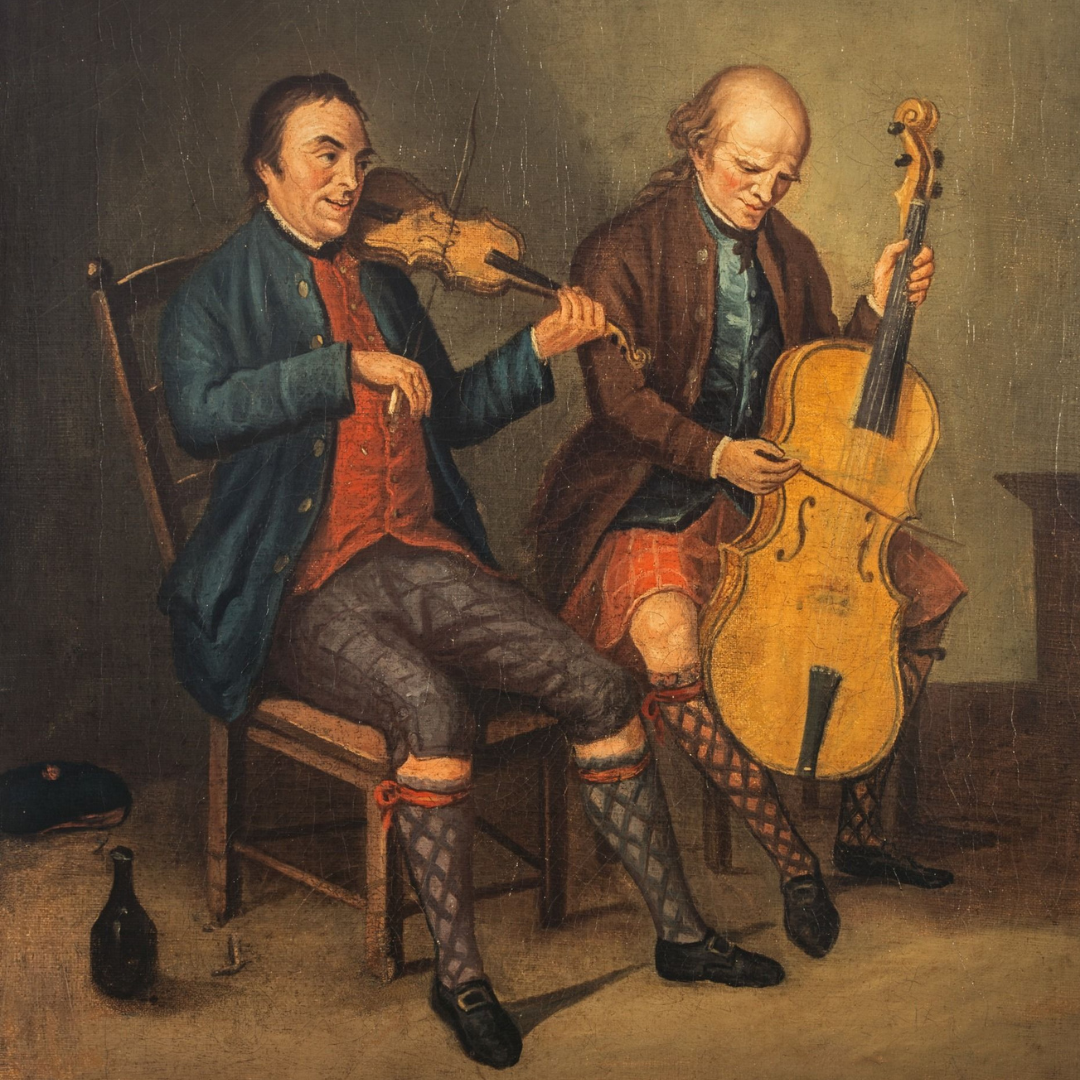
There's a very famous painting called Highland Wedding. David Allen is the artist, end of the 18th century.
And there's a wedding taking place and there's people dancing outside.
So in the front, front frame you've got the wedding couple, the bride and groom, who are very well dressed and have been to their dancing lessons. And their feet are pointing the right way and everything is beautiful and they're very poised. And then over to one side you've got the musicians, you've got Neil Gough the fiddler and his brother Donald playing the cello. But then there's another couple also dancing at the same time behind them.
And it looks totally different, It's a bit wilder. They're not dressed quite so ornately. And it's the man who's particularly funny because he's got quite a short kilt on and it doesn't quite come all the way around. So he's showing quite a lot of leg, he's having a brilliant time. And it's the same dance, it's the same music, it's the same occasion, but they're doing the same thing, completely different registers.
And I think.
I mean, this works for instruments and for singers as well. Because what I'm concerned about is not so much getting the pronunciation historically correct, though that is fascinating. And, you know, getting the vowel sounds.
[00:15:08] Speaker D: And
[00:15:10] Speaker C: I think that's terrific work. But what I think I'm most concerned at is how does this read to the audience? What is this saying about the character who's singing it and where they come from and what kind of person they are? Certainly in Britain, until quite recently, the only way that you could sing classical music in English was to pretend that you'd grown up in the southeast of England and gone to one of the oxbridge universities, say, 30, 40 years ago, and had that accent and that voice. But I think that sends a very 20th century message about what kind of people are allowed to participate in that kind of culture.
And I think that's pernicious.
But also, we know that 17th and 18th century musicians were not from a uniform social group or a uniform ethnic group.
What I'm interested in is what kind of person is this singer being?
What's their place in society? This music is not about being very comfortable with our way of life. And actually everything is fine in our culture. Thanks. And this is how it is.
That's not what life would.
It was a bit more precarious. And the fact that you can hear that sense of all the different bits of society coming together in this music is much more interesting to me than getting the right vowels, though I do like it when people get the right vowel.
[00:16:33] Speaker B: That's so fascinating to me. I've spent a little bit of time in England, just enough to appreciate that there are all of these. It's an incredibly rich, vibrant regional accents. It's amazing, actually, how much you signal to other people when you open your mouth, a whole range of information about yourself. I hope that there's not too much lost in translation, but this is an American soprano here singing A Country Lass.
[00:17:00] Speaker A: Let's listen now to soprano Elena Mullins Bailey perform A Country Lass with Lad Elyse from their acclaimed album the Highland Lassie.
[00:17:10] Speaker D: Although I be model country lass, A lofty mind I be I think myself as good as those that reach a wear O thou my garment is hence van gray My skin neck as soft wool as them that sight hasty way and carry their heads aloft. O.
Tho my parents cannot raise great bags of shop like lamb was daughters nowadays like swine or bought and sold all yet my fair body shall keep an honest heart within home and for twice 50,000 crowns I vow I.
Here I did not care My hands I can in gravel Expecting for a blessing still descending form of wo Then we embrace and solidification.
[00:19:47] Speaker A: Thanks so much for listening to Solanira. Solaniera is a production of Les Delice, made possible by donations from viewers and listeners like you. We rely on the generous contributions of listeners and fans to cover artist fees and production expenses, as well as support the hours of research and planning that go into each program.
Now, in our seventh season, we offer two different episode formats. You're currently listening to an audio exclusive, an hour long podcast episode new this year. You can also listen or watch on YouTube. Saloniera spotlights shorter episodes that highlight a specific piece or topic.
Saloniera Spotlights and audio exclusives are available on all major podcast platforms, YouTube and directly via the Salon Era website, where you can also find guest bios and episode specific resources and and make tax deductible donations to support production.
If you love Solan Era's unique combination of performance and conversation about early music artists, composers, history and more, please consider making a donation or sign up for our mailing list@salon era.org thanks for your support.
[00:20:51] Speaker B: Okay, so David, you've touched on this a little bit in your earlier comments about the baselines of this music and coming at it from like a harpsichordist perspective, how they don't really feel like continual lines. Could you tell us a little bit more about the bass lines of this music and what they're for?
[00:21:11] Speaker C: Yeah, what I found was I tried to play them as though they were continual parts and I thought it just doesn't sit under the fingers, it doesn't flow. The harmonies don't do those things. It took me a long time before I started to uncover what it was, which is that there is a tradition going right into the early 20th century of four beats in the bar, four notes to the bar, bass lines for particularly reels and stress bass. That's it that's what works. I thought, wow.
And see, the printed sources don't do that, because piano parts start to arrive the end of the 18th century. The reason that those first appear is very clear in that pianos start being sold in Edinburgh in 1784, which is the year that Neil Gough's first book comes out.
So when it's time to renew the copyright for that book in 1801, Nathaniel Gow says, well, you know, this is a revised edition, it's got a few new things. And also there were certain things that require correction.
And the things that required correction were the things that wouldn't work on the piano, where a particular style of accompaniment was there, which harmonically might be quite static, it might be sort of drone based, that gets transformed into something that that has more harmonic movement in it and really changes the music.
But so until you hit the 20th century, most Scottish fiddle music, the sort of standard texture for it is two part texture, the tunes. At the top, there's a bass line, at the bottom, nothing else. You don't need chords because, you know, normally people ask, first thing you ask, what the chords for this tune? Well, you don't actually need them. If you've got the bass line right, all the harmonic information is there and it sounds great without adding anything.
What else?
Oh, yeah, this is from Playing for Dancing.
You can just play one tune per dance. Generally, for a dance, you would play this just one tune over and over again for as long as it took, and that could be well over an hour.
[00:23:17] Speaker B: When you're talking about this performing music, not just, you know, to record an album, not just in a sort of staid concert environment, but to play while people are really dancing.
I know that you have participated in a historical reconstruction of an Edinburgh ball and what was that like?
[00:23:37] Speaker C: The great Gaelic singer and many other things besides. Tulsa Mackenzie was doing a lot of historical dance and she wanted to stage Nathaniel Gow's annual ball. Nathaniel Gough would have his annual benefit ball in the Edinburgh Assembly Rooms and there was a dance card and his new set of quadrilles would be danced and all the rest of it. So we know what was danced on what night.
So we were doing it 200 years later to the day, same dances, same music and people coming from all over the world in full costume to do it. Having learned the dances, it was amazing. And we had the late Stuart Marsden, wonderful dance specialist, calling the dancers in French from the stage.
And it was absolutely amazing. It was like walking onto a film set. And acoustically it was fascinating because there Were four of us playing on old instruments, a hundred people dancing, and I thought, they're just going to drown us out. But actually, of course, the bandstand is a couple of meters off the ground, and it's got an alcove with a curved back, so the sound is just projecting out above everybody. And so there's that. And just the sheer thing of looking down and seeing the social interaction of the dances going on and seeing how people caught each other's eye, and all of that was utterly fascinating.
And then, of course, discovering that Nathaniel Gao once hired a piano to go in there meant that I had a legitimate reason to be in the band.
[00:25:22] Speaker B: Yeah. Not just a love of knickers and wearing fancy little coats.
[00:25:29] Speaker C: We did get our photos taken once we were in costume. That's true.
[00:25:33] Speaker B: But we will link any photos that I can find on the website. So, David, you've mentioned a few times this name, Nathaniel Gal, and I know that he also served as inspiration for at least one of your albums, Nathaniel Gal's Dance Band. Can you tell us a little bit more about Neil and Nathaniel Gao, just to give listeners who are not Scottish a little clue into the importance of these figures?
[00:25:59] Speaker C: Well, Neil was kind of, you know, a really a legendary musical figure in Scotland in his own time. Somewhere there's a little record of how much fiddlers would be played, you know, so a small fiddle, which is a violin, and then a bass fiddle, cello. And then there's the other category, which is Neil Gough, who gets paid, like, four times as much as everybody else, because he's Neil.
His son Nathaniel sort of took on the family business, really, and was a very successful band leader, publisher, and really sort of carried on the family name in a culture where, you know, dynastic families were normal.
[00:26:41] Speaker B: Well, we're gonna listen next to a set of dance tunes you've called duff, from a 2007 album, Lion.
[00:26:48] Speaker C: Yeah, these are tunes by William Marshall. And now, William Marshall had a very respectable job. He was a factor to the Duke of Gordon at Gordon Castle, which was a position of great responsibility, basically running the estate. You know, whenever the Duke wasn't there, he was in charge of running the whole operation.
And his first two books of tunes were published In Edinburgh, actually, 40 years apart, because I think he was just so busy in the interim doing his job. And the tunes, he said his tunes weren't for bunglers, but they're great fun to play. So the first of these tunes, it's from his 1781 book, which has a sort of very agile Cello, bass line.
And I have to say I'm being extremely unhistorical and playing melodica in the first tune.
And then the others are from, I think the 1822 and 1844 books for the bass lines were written by.
Apparently Marshall had no knowledge of harmony, so his friend, the Anglican priest George Gordon down the road, who also produced a book of sacred choral music, wrote those bass lines.
[00:27:54] Speaker A: Let's listen now to a collection of dance tunes by William Marshall. This track is titled Duff, and it's from Concerto Caledonia's 2007 album Lion.
[00:31:26] Speaker B: Yes. So, Deborah, we're going to hear next a piece of music that we actually featured in the Mermaid, which is coming back at the end of this season.
Can you tell us a little bit about John, Come Kiss Me Now?
[00:31:40] Speaker E: Yeah, well, John, Come Kiss Me now is a very, very old tune dating back to the 17th century. But the. That we're going to hear was published several times, the first of which that I'm aware of is probably from a 1759 print by Robert Bremner. I don't exactly know who wrote the Variations themselves. It could have been Bremner, it could have been another violinist.
But it's a really long variation set and they're very cool. Allison Monroe is the violinist here, along with Rebecca Landell on cello, and Shawn Dagger is playing Irish bouzouki, and Anthony Tadeo joins in some. Some ways along on percussion. And, yeah, it's just a fabulous set From Live Performance, April 20.
[00:32:40] Speaker D: 20.
[00:36:49] Speaker B: Well, David, I don't think it would be right to have a Scottish person on a podcast and not ask them about Robbie Burns.
So we have to. We have to talk about him.
He played this incredible large role in collecting and codifying Scottish ballads through his work on the Scots Musical Museum. Can you describe this and what kind of importance it has to you and modern musicians?
[00:37:22] Speaker C: It's a fascinating collection. I mean, it's six volumes with 100 songs in each. And it took him. Well, it wasn't just him. It took 16 years for them all to come out and work on. It really took up quite a lot of the last few years of his life.
And he was building on earlier work, particularly Alan Ramsey. Burns was. Well, he was operating in a different cultural environment, and where people were becoming interested in what Scottishness was, the sort of glib explanation of what was going on in the 18th century is that the English were so busy building an empire that they didn't notice that they had their own culture.
And so when this thing, Britain came Into being in 1707, all the Scots in London went, oh, you need some British culture. We've got some.
And which is one of the reasons perhaps why Scottish music became such a big thing in the middle of the 18th century in London. My colleague at the University of Glasgow, Murray Pittock, edited the Scots Musical Museum for Oxford University Press quite recently, and he has eight different categories for the songs, depending on how much Burns did to them. You know, whether he wrote them from scratch, did nothing at all. The achievement of the book and the range of songs and the care he takes with the way they're presented, it's really remarkable that it still stands up today as an incredibly useful document as it is.
[00:38:49] Speaker E: Yeah,
[00:38:52] Speaker B: wonderful. The last thing that we'll hear on this episode is a setting of Byrne's Highland Mary to the tune.
Ooh, David, how do you say this? Catherine.
[00:39:02] Speaker C: Catherine. Ogie.
[00:39:04] Speaker B: Ogie.
[00:39:04] Speaker C: Okay, could be Ogie.
[00:39:05] Speaker B: Could be Og. Could you say that?
I should have just moved with confidence.
[00:39:10] Speaker E: Interestingly, there's no Highland Mary in the Scots Musical Museum. Highland Mary was a very famous poem by Burns and the source of some great mythology about his love, Highland Mary, who was actually identified later by scholars as Margaret Campbell. Not Mary at all. It was a very short lived, red hot love affair about four weeks long, and she died of typhus at age 23. And so he was heartbroken and she took on a huge presence in this kind of cultural mythology and imagination around Burns. And so while Highland Mary is not in the Scots Musical Museum, he did say that it could be sung to the tune of Catherine Augie. So I put these two things together. That's the tune we hear, and also with variations in a reel on the same tune by James Oswald in a live performance by Les Delices with tenor Jimmy Reese from January 2020.
[00:41:23] Speaker D: Sam.
How sweetly bloomed the gay green look how rich the blossom as underneath the fragrant shade I can.
Sam.
But wolf and timely frost that nicked my flower.
Now cold and pale Whose rosy lips I oft have kissed with honor and comes for I the sparkling a that looked see kindly and.
Dust.
Shout.
[00:47:10] Speaker A: Thanks so much for listening to this episode of Salon Era. This episode, the first audio exclusive of our seventh season, was created by executive producer Deborah Nagy, Associate producer Shelby Yaman, and me, your host, Hannah DePriest, scriptwriter and special project manager. For this episode, I spoke with David McGinnis, harpsichordist, composer and director of early music ensemble Concerto Caledonia, and Lady Lis, founder and artistic director Deborah Nagy.
Support for Salon Era is provided by Cuyahoga Arts and Culture, the Ohio Arts Council, and audience members like you.
In this episode, you heard music from Ladalis acclaimed album the Highland Lassie and music from live performances of late Elise programs the Mermaid and A Red Red Rose. You also heard tracks from two albums by Concerto, Caledonia lion and the fiddler Tam.
This project was made possible by our Salon ERA season sponsors Jerry Fathauer and Jeff Hutchinson, Tom and Marilyn McLaughlin and Joseph Sapko and Elizabeth McIntyre.
Les Delyse receives general operating support from the Ohio Arts Council, Cuyahoga Arts and Culture, and the Paul M. Angell Family Foundation.
I hope you'll subscribe and leave a review on whatever platform you're listening on. It really helps the show from all of us. Thanks for listening and have a great day.